The right bakery or cake shop equipment is the smallest system that can produce the planned menu at peak demand while keeping food safe and workflow one-directional. Start with product mix and batch data, size the mixer-oven-proofer-refrigeration chain to the bottleneck, then verify utilities, ventilation, service access, and local compliance before ordering.
Quick Decision Summary
Choose equipment as a connected production system, not as isolated machines. The menu defines the process; peak output defines capacity; food risk defines refrigeration; the building defines utilities and layout; and the destination market defines documentation and compliance. A low purchase price cannot compensate for a bottleneck, an unusable utility connection, or a cabinet that fails under real ambient conditions.
- Cake and patisserie operations: prioritize planetary mixing, controlled cold preparation, finishing space, product-specific storage, and a refrigerated display only for products that require chilled holding or benefit from it.
- Bread-led bakeries: prioritize dough handling, spiral mixing, controlled proofing or retarding, the correct oven type, rack movement, cooling capacity, and dry storage.
- Bakery cafes: balance production with front-of-house display, beverage workflow, frequent replenishment, customer circulation, noise, and heat rejection.
- Wholesale or central kitchens: design around throughput, batch traceability, rapid cooling where the process requires it, packaging, dispatch, redundancy, and service access.
- For every format: confirm model-specific dimensions, utilities, rated capacity, test conditions, refrigerant, cleaning access, documentation, spare parts, and local service before purchase.
- What Equipment Does a Commercial Bakery or Cake Shop Need?
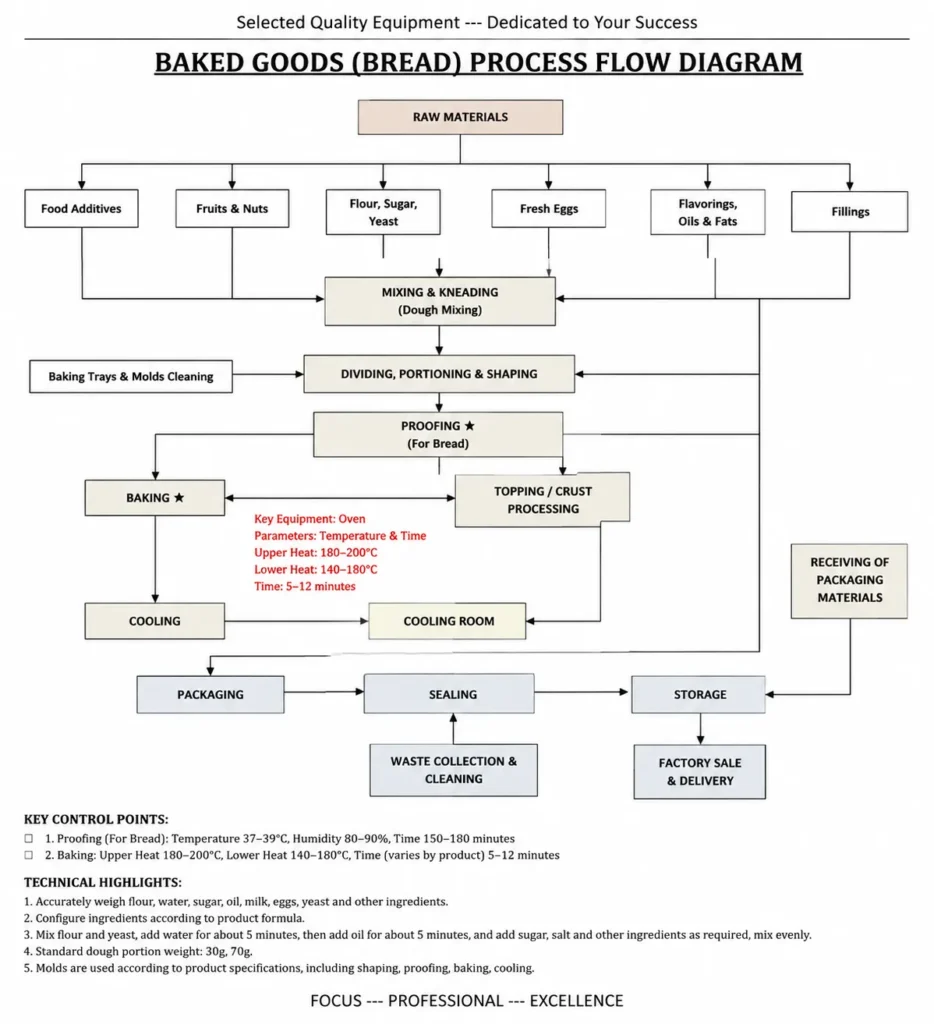
Most commercial bakeries need seven connected functions: receiving and storage; weighing and mixing; forming or depositing; proofing or temperature control; baking; cooling and finishing; and display, packing, cleaning, and waste handling. The exact machines depend on the menu and output. Equipment is essential only when it removes a real capacity, consistency, safety, or labor constraint.
| Process stage | Core equipment | Add when the menu or volume requires it | Main buying risk |
| Receiving and storage | Dry shelving, ingredient bins, scales, reach-in or walk-in cold storage as required | Freezer, dedicated dairy/cream storage, flour handling system | Insufficient usable capacity or poor stock rotation |
| Weighing and mixing | Bench scales, planetary mixer for batter, cream and fillings | Spiral mixer for bread dough; bowl lift; ingredient dosing | Comparing bowl volume instead of usable product capacity and duty |
| Forming and makeup | Work tables, hand tools, pans and racks | Sheeter, divider, rounder, depositor, moulder | Automation that exceeds real throughput or cannot match product range |
| Proofing and scheduling | Controlled proofing where fermented dough is central | Retarder-proofer for overnight scheduling and repeatability | Capacity does not cover overlapping batches or rack format |
| Baking | Convection, deck, or other oven selected by product and batch plan | Rack oven, steam system, multiple temperature zones | Oven capacity, recovery, utilities, and extraction are not validated together |
| Cooling and finishing | Cooling racks, clean finishing benches, utensils | Blast chilling/freezing, chocolate or cold prep zone, depositor | Cooling becomes the hidden bottleneck or crosses dirty traffic |
| Display and dispatch | Ambient or refrigerated display matched to product; packaging and labeling area | Remote display line, frozen display, order staging | Merchandising case is mistaken for storage or pull-down equipment |
| Cleaning and waste | Handwashing, warewashing, chemical storage, floor and waste provisions | Rack washer, utensil washer, dedicated allergen-cleaning tools | Hygiene infrastructure is added after equipment positions are fixed |
Expert Insight: The most expensive machine is not automatically the most important. First protect the constraint that limits saleable output. A large oven adds no capacity if the mixer, proofer, cooling racks, decorators, or chilled storage cannot feed and clear it on time.
- Match the Equipment Package to the Bakery Format
The correct equipment package changes with the business model. An artisan bread bakery needs fermentation and oven control; a cake shop needs cold-chain and finishing control; a bakery cafe must integrate production, display, drinks, and customer flow; a central kitchen needs repeatable throughput and dispatch. Choose the format first, then specify the machines.
| Bakery format | Best for | Equipment emphasis | Layout and refrigeration priority |
| Artisan bread bakery | Sourdough, baguettes, hearth breads | Spiral mixer, divider or bench makeup, proofer/retarder, deck oven, racks | Straight dough flow; dry storage; controlled fermentation; generous cooling |
| Cake and patisserie shop | Celebration cakes, mousse, cheesecake, plated pastries | Planetary mixer, convection oven, finishing benches, cold storage, selected display | Separate hot production from cold finishing; protect delicate products from strong airflow |
| Bakery cafe | Mixed bakery range plus drinks and light food | Flexible mixing and baking, undercounter cold storage, displays, beverage station | Fast replenishment; customer queue; low front-of-house heat and noise |
| Wholesale or central bakery | Multi-outlet supply, packaged products, high batch volume | Higher-throughput makeup, rack handling, cooling, packing, traceability, dispatch | One-way production; staging; cleaning separation; redundancy planning |
Which Should You Choose?
- Choose a bread-led system when fermented dough is the core revenue driver and crust, steam, proofing, and dough temperature control matter more than display variety.
- Choose a cake-led system when chilled ingredients, finishing labor, decoration, portion presentation, and product-specific display conditions drive quality.
- Choose a hybrid system when bread, pastry, cakes, and drinks all matter – but separate the hot production path from cold finishing and avoid forcing one machine to perform incompatible duties.
- Choose a central-production system when the project serves multiple outlets; design backward from dispatch time, packaging format, shelf-life validation, and outlet replenishment.
- How to Size Bakery Equipment Without Guessing
Size each machine from peak saleable output, the largest regular batch, cycle time, product changeovers, yield, and the productive hours actually available. Then test the full chain for bottlenecks. Daily sales averages are not enough: they hide morning peaks, overlapping proofing, oven recovery, decoration labor, cooling time, and door-opening loads on refrigeration.
Start with a production model
For each major product family, record saleable units required in the peak production window, units per pan or tray, pans per batch, batch weight, mixing time, rest and proof time, bake time, loading and unloading time, cooling time, finishing time, and chilled or frozen holding needs. Use measured recipe yields where available; otherwise mark the value for a trial run.
A practical capacity equation is: required hourly output = saleable units required in the peak window divided by productive hours available. Equipment capacity must then be checked at the specified product, load, and cycle – not at an unrelated maximum or an empty-cabinet condition.
Check the capacity chain, not one nameplate
- Mixer: verify maximum and minimum practical load, product-specific duty, bowl change time, motor protection, attachments, and whether the stated capacity is flour, dough, liquid, or bowl volume.
- Proofer or retarder: count all batches that overlap, confirm rack or tray compatibility, and include loading, unloading, sanitation, and recovery.
- Oven: calculate saleable units per load multiplied by realistic loads per hour; include preheat, loading, recovery, steam, temperature changes, and rejected product.
- Cooling: provide enough rack and clean floor capacity for every hot batch to clear the oven without blocking traffic or finishing.
- Refrigeration: calculate usable shelf or rack capacity and heat load under the intended ambient, product-entry temperature, door openings, defrost, lighting, and replenishment pattern.
- Display: size the visible assortment and replenishment interval, not the entire day’s inventory. Overstocking can obstruct airflow and reduce visual clarity.
Use one handling standard across the line
Normalize the project around the intended pan, tray, rack, bowl, and transport formats before comparing equipment. A mismatch between the oven, proofer, racks, blast chiller, cold room, and display creates manual transfers, extra labor, damaged products, and unusable nominal capacity. Ask suppliers to state compatible internal dimensions and loading patterns for the exact model.
Expert Insight: Do not apply a generic growth percentage to every machine. Add flexibility where expansion is difficult – utilities, extraction, floor space, cold-room panels, and oven provision – while modular equipment can be added later if the layout and services allow it.
- Bakery Refrigeration: Storage, Production, and Display Are Different Jobs
Choose bakery refrigeration by product risk and process duty. Storage cabinets hold already-chilled stock; worktop units support frequent access; retarder-proofers control dough schedules; blast chillers remove heat quickly; display cases merchandise products. One cabinet should not be assumed to perform all five jobs, and there is no universal safe ‘cake display temperature’ for every recipe.
Classify the food before selecting the cabinet
First determine whether each product requires time/temperature control for safety under the destination market’s rules and the bakery’s validated process. Cream, custard, cheesecake, soft-cheese fillings, cut fruit, and other high-moisture components can change the classification; recipe formulation and post-bake handling matter. Dry breads and many low-moisture bakery products may be ambient products, but their shelf life and quality still require validation.
As a U.S. reference point, the 2022 FDA Food Code is a model code and specifies cold holding for time/temperature control for safety food at 5 degrees C (41 degrees F) or less. The UK Food Standards Agency separately advises that cakes with high-moisture additions such as fresh cream should be chilled. These examples do not replace local legal advice, a product assessment, or a HACCP-based food-safety plan.
Regulatory context: FDA Food Code 2022; FDA Food Code 2022, print version; UK Food Standards Agency guidance on providing food at community and charity events
Select refrigeration by duty
| Refrigeration type | Primary job | When to choose | What to verify |
| Reach-in or walk-in storage | Hold chilled ingredients and finished stock | Reserve inventory, bulk dairy, prepared fillings, finished cakes | Usable load, shelf/rack fit, door recovery, ambient rating, alarms, cleaning |
| Undercounter or worktop refrigerator | Frequent-access ingredients at point of use | Cold finishing, sandwich or beverage prep, compact sites | Ventilation path, drawer/door load, condenser access, heat near work area |
| Retarder-proofer | Schedule and control fermented dough | Overnight production, variable climate, labor smoothing | Temperature/humidity control, program logic, rack fit, recovery, sanitation |
| Blast chiller or freezer | Rapidly remove product heat | Validated rapid-cooling process, mousse/gel setting, production scheduling | Loaded pull-down duty, probe/control method, product mass, drain, cycle data |
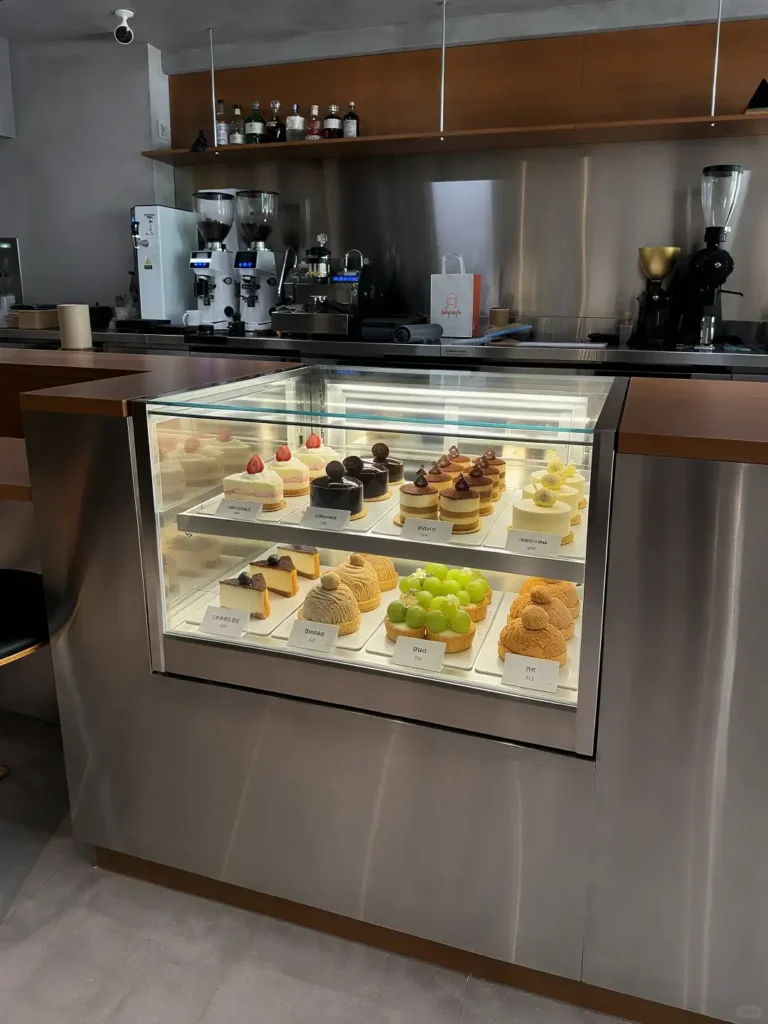
| Refrigerated display | Hold and merchandise sale products | Products requiring chilled holding or a chilled quality condition | Shelf temperature distribution, airflow, glazing, condensate, lighting heat, access |
| Ambient display | Protect and merchandise non-chilled products | Bread, cookies, and products validated for ambient display | Dust/pest protection, access mode, crumb cleaning, humidity and staling risk |
How to evaluate a cake display refrigerator
- Food duty: state the exact products, loading temperature, replenishment pattern, operating hours, and whether the case is for holding only or is expected to pull products down.
- Temperature evidence: request the operating range, control tolerance, test ambient, shelf-by-shelf data where available, recovery behavior, defrost method, and alarm functions.
- Product quality: ask how airflow and humidity are managed, then validate with the actual cake, icing, glaze, fruit, and packaging. Avoid unsupported claims that one humidity level suits every product.
- Site fit: confirm external and internal dimensions, door or rear access, service clearance, air discharge and intake, heat rejection, sound level, drain or condensate method, and delivery route.
- Electrical and refrigerant data: confirm voltage, phase, frequency, connected load, plug or isolator, refrigerant designation, charge, GWP where relevant, and service availability in the destination market.
- Merchandising: check usable display area, shelf load, glass type, condensation control, lighting, sightlines, customer or staff access, and cleaning of tracks and corners.
- Energy comparison: compare declared daily or annual consumption only when test methods and operating conditions are equivalent. Open, glazed, remote, and storage equipment are not directly interchangeable categories.
- Bakery Layout: Build a One-Way Product Flow
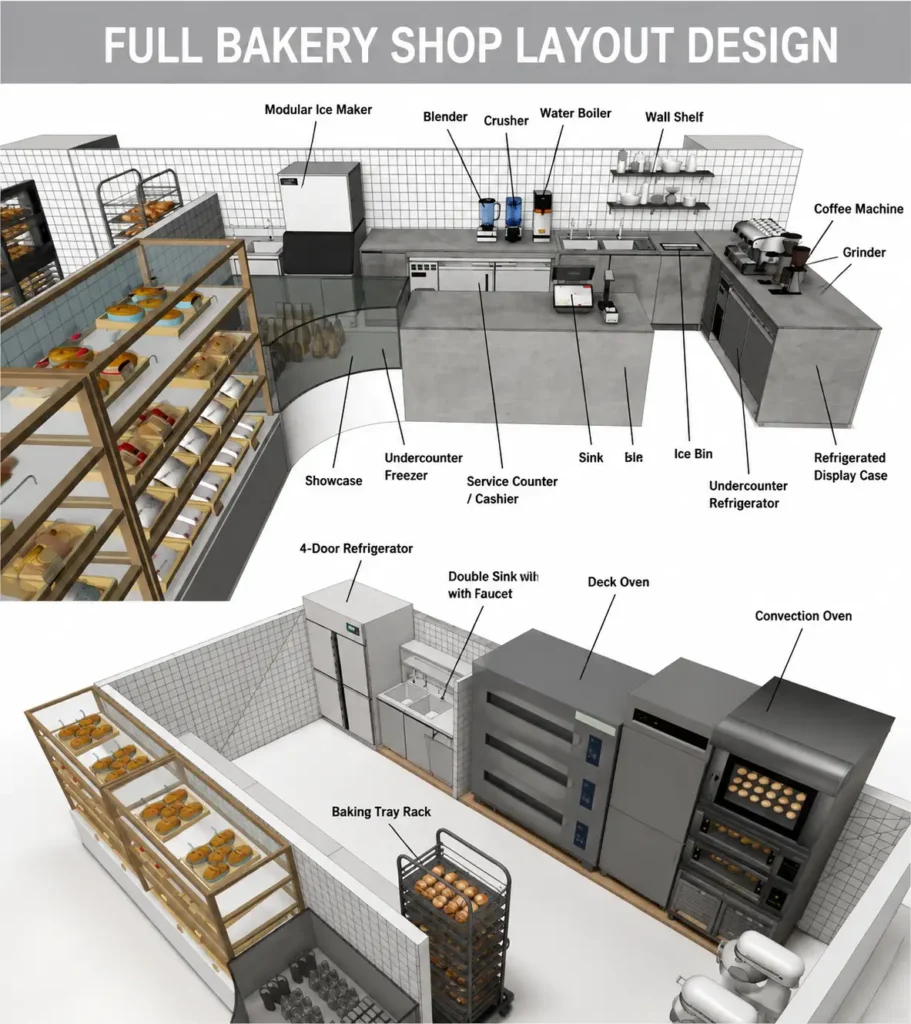
A good bakery layout moves ingredients and products forward: receiving and storage, weighing, mixing, forming, proofing, baking, cooling, finishing, display or packing, and dispatch. Warewashing, waste, allergens, and staff circulation should not cut across ready-to-eat finishing. The objective is fewer crossings, shorter handling, cleanable access, and safe service space around every machine.
Create functional zones and adjacencies
- Receiving and storage. Provide dry, chilled, frozen, packaging, and chemical storage with clear stock rotation and a practical delivery route.
- Scaling and mixing. Place ingredients, scales, bowls, water, and mixers to minimize carrying and flour spread while preserving cleaning access.
- Makeup and proofing. Keep benches, dividers, sheeters, racks, and proofers in the order used; avoid rack turns through customer or washing traffic.
- Baking and hot handling. Allow safe loading, unloading, rack parking, ventilation, heat shielding, and a clear path to cooling.
- Cooling and ready-to-eat finishing. Move cooled products into a protected clean zone near cold storage, decoration tools, packaging, and order staging.
- Display and dispatch. Separate the customer queue from replenishment and delivery paths; preserve sightlines without forcing staff through production.
- Warewashing and waste. Keep dirty returns, chemicals, drains, refuse, and clean utensil storage from contaminating ready-to-eat work.
Hygiene framework: Codex Alimentarius General Principles of Food Hygiene (CXC 1-1969); UK Food Standards Agency MyHACCP prerequisite guidance; Regulation (EC) No 852/2004 on the hygiene of foodstuffs
Verify utilities and installation before the purchase order
- Access route: check crate dimensions and weight, doors, lifts, stairs, turning radius, floor loading, rigging, and final positioning.
- Equipment envelope: show operating clearance, door swing, rack movement, removable panels, filter access, condenser airflow, and service withdrawal space – not only the cabinet footprint.
- Electricity: confirm supply voltage, phase, frequency, connected load, starting current where relevant, plug/isolator, circuit protection, earthing, and local installation responsibility.
- Gas and ventilation: confirm fuel, pressure, combustion air, flue or hood requirement, make-up air, fire protection, and permits with the local authority and engineer. Requirements depend on appliance and jurisdiction.
- Water, steam, and drainage: confirm water quality, pressure, treatment, connection size, steam generation, floor or trapped drain, condensate disposal, backflow protection, and cleaning method.
- Room condition: record design ambient temperature and humidity, sunlight, nearby heat sources, air-conditioning, noise limits, and where condenser heat will go.
- Safety: assess guarding, hot surfaces, emergency stops, manual handling, flour dust control, slip risk, and access for shutdown and cleaning.
U.S. example for bakery machinery and flour-dust controls: OSHA 29 CFR 1910.263 – Bakery equipment
Layout Red Flags
- Raw ingredient, waste, or dirty-utensil traffic crosses cooled, decorated, or packed ready-to-eat products.
- Cooling racks sit in a hot zone, doorway, customer path, or wash-up route.
- A display case is placed in direct sun, beside an oven, or where condenser air cannot escape.
- Equipment is drawn to scale, but doors, racks, service panels, filters, and operator positions are not.
- Handwashing, warewashing, drainage, chemical storage, or waste is added after the production layout is fixed.
- The plan has no quarantine, allergen-control, packing, order-staging, or rejected-product space.
- Future machines are shown without spare electrical load, ventilation capacity, drainage, or access route.
- Oven, Mixer, Proofer, and Display: Which Should You Choose?
Choose the machine whose heat transfer, mixing action, process control, capacity, and handling format match the dominant product. Convection ovens favor even fan-assisted batch baking; deck ovens favor products needing strong deck heat and steam control; spiral mixers favor bread dough; planetary mixers favor batters, creams, and varied attachments. Validate every choice with product trials.
| Choice | Best for | Choose when | Red flag or limitation to test |
| Convection oven | Cakes, cookies, pastries, flexible batch work | Even air circulation and versatility matter; product tolerates fan movement | Fan can affect delicate products; verify recovery, tray loading, and bake uniformity |
| Deck oven | Artisan bread and products needing deck heat | Independent decks, steam, and crust control are important | Footprint, loading labor, heat, ventilation, and changeover flexibility |
| Rack oven | High-throughput, rack-based production | Full-rack handling and repeatable volume justify the system | Upstream and downstream capacity, rack compatibility, floor and utility demand |
| Spiral mixer | Bread and developed dough | Dough quality, batch repeatability, and heat control dominate | Minimum load, bowl configuration, dough range, guarding, and discharge height |
| Planetary mixer | Cake batter, cream, icing, fillings, lighter dough | One machine must perform several mixing actions with attachments | Do not assume dense-dough capacity from bowl volume; verify duty chart |
| Proofer | Same-shift controlled fermentation | Temperature/humidity consistency is needed without overnight scheduling | Rack capacity and recovery do not match overlapping batches |
| Retarder-proofer | Overnight dough scheduling | Labor timing and repeatable morning readiness matter | Program transition, sanitation, backup plan, and refrigeration service |
| Ambient display | Validated non-chilled breads and dry pastries | Texture and rapid service matter more than chilled holding | Dust, customer contact, humidity, staling, and labeling |
| Refrigerated display | Products requiring chilled holding or chilled presentation | Food-safety classification and validated quality require it | Strong airflow, uneven shelves, condensate, heat load, or holding-only limitation |
When to Choose an Upgrade: Upgrade only when it improves a measurable constraint – saleable output, batch consistency, labor exposure, scheduling, energy, food safety, cleaning time, product damage, or service continuity. Ask how the claimed benefit will be tested at acceptance.
- Compare Total Installed Fit, Not Purchase Price Alone
A professional equipment comparison should cover total installed cost, performance evidence, utilities, compliance, cleanability, service, energy, spare parts, and downtime risk. Compare quotations only after every supplier has answered the same requirement schedule. Unpriced exclusions – installation, site work, commissioning, or certification gaps – can be more important than the machine price.
Build a model-by-model requirement schedule
- Identity: manufacturer, exact model, revision, country of manufacture, data plate sample, and quotation validity.
- Performance: rated capacity by product, cycle time, control range, accuracy or tolerance where applicable, test load, test ambient, recovery, and any exclusions.
- Physical data: external/internal dimensions, net/gross weight, loading format, shelf or rack count, door swing, service clearance, crate dimensions, and lifting points.
- Utilities: voltage, phase, frequency, connected load, protection, plug/isolator, gas, water, drain, steam, exhaust, heat rejection, and noise.
- Materials and cleaning: food-contact materials, removable parts, gaskets, corner design, drainage, access to coils/filters, approved cleaning method, and sanitation documentation.
- Refrigeration: refrigerant designation, charge, GWP where applicable, cooling method, defrost, condensate, ambient class, controller, alarms, and service access.
- Market documentation: the exact model’s declarations, certificates, test reports, labels, manuals, and listing links required by the destination market and local authority.
- After-sales: warranty scope and location, exclusions, response process, commissioning responsibility, parts list, recommended spares, lead times, and technician availability.
Verify compliance by model and destination market
For North American foodservice projects, sanitation and electrical safety are separate questions. NSF/ANSI 7 covers commercial refrigerators and freezers, while NSF/ANSI 8 covers powered food preparation equipment such as mixers. FDA guidance recognizes appropriate American National Standards as a basis for sanitation compliance. UL identifies UL 471 or UL/CSA 60335-2-89 among standards used for commercial refrigeration equipment. Confirm the current listing for the exact model; a logo in a brochure is not model-level evidence.
North American standards context: NSF Food Equipment Standards portfolio; FDA list of American National Standards for food equipment; UL Solutions: code requirements for mechanical refrigeration systems
For the European Economic Area, CE marking is the manufacturer’s conformity declaration under applicable EU harmonization rules; the European Commission states that it is not an EU safety approval. Request the EU Declaration of Conformity and verify that the exact model, responsible economic operator, applicable legislation, and referenced standards are coherent. Refrigeration buyers should also check refrigerant and equipment category against Regulation (EU) 2024/573 and its staged restrictions. Obtain market-specific compliance advice before import or installation.
EU market context: European Commission guidance on CE marking; Regulation (EU) 2024/573 on fluorinated greenhouse gases
Calculate total installed and lifecycle cost
Use a complete comparison: equipment price + packaging and freight + insurance and duties + delivery and rigging + site modifications + installation and commissioning + required accessories + training + expected energy and consumables + preventive maintenance + critical spares + expected downtime exposure + end-of-life obligations. Use local quotations and the same time horizon for every option; do not substitute generic online price ranges.
Procurement Red Flags
- Capacity is stated only as bowl volume, cabinet volume, tray count, or a marketing label, without product, load, cycle, or ambient conditions.
- A refrigeration supplier provides only a controller set point or empty-cabinet result, not loaded holding or recovery evidence.
- The quotation omits refrigerant, charge, voltage/phase/frequency, heat rejection, drain, plug/isolator, or installation exclusions.
- A certification mark is shown, but the exact model cannot be found in the certification body’s current listing or the supporting document has a different model code.
- The CE Declaration of Conformity is generic, unsigned, issued for another product family, or does not identify the responsible manufacturer and applicable legislation.
- No operating, cleaning, wiring, parts, or installation manual is available before shipment.
- The supplier cannot state crate size and weight, service clearances, spare-parts lead time, or who will commission the unit in the destination market.
- Warranty language does not distinguish parts, labor, travel, refrigerant, glass, consumables, commercial use, and geographic coverage.
- Commissioning and Acceptance Checklist
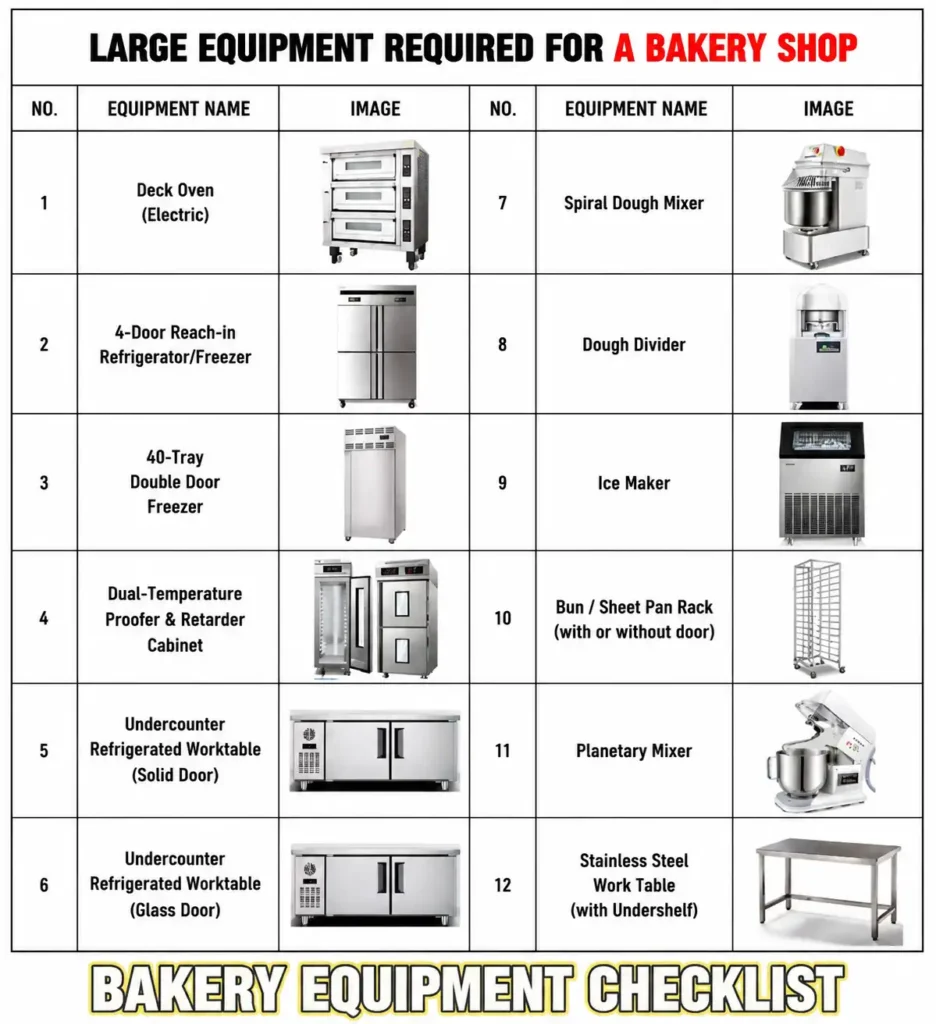
Agree the acceptance method before placing the order. Commissioning should confirm identity, transport condition, utilities, safety controls, loaded performance, cleaning access, alarms, documentation, and operator training. Record the baseline results and unresolved items in a signed handover. A machine that merely switches on has not necessarily met the purchase requirement.
Before shipment
- Approve final model schedule, drawings, utility data, finishes, loading format, accessories, labels, manuals, certificates, and packing method.
- Confirm destination voltage, phase, frequency, refrigerant rules, plug/isolator, language, and data-plate information.
- Agree factory checks or witnessed tests where the project risk justifies them, including what constitutes pass or fail.
- Confirm crate dimensions, weights, lifting points, shipment split, moisture protection, spare parts, and document pack.
At delivery and installation
- Inspect packaging, impact indicators where used, glass, panels, frames, doors, gaskets, accessories, and concealed damage before signing acceptance.
- Match model, serial number, voltage, frequency, refrigerant, and accessories to the approved schedule and data plate.
- Verify level, clearances, ventilation, drain, power protection, water/gas connections, anchoring, and safe access before startup.
- Follow the manufacturer’s settling, startup, commissioning, and cleaning instructions; do not improvise after transport.
Loaded performance and handover
- Run the agreed product or representative load under the intended ambient and operating pattern, not only an empty test.
- For refrigeration, record stabilized product temperatures, shelf distribution where relevant, recovery after access, defrost behavior, alarms, condensate, noise, and controller settings.
- For ovens, mixers, proofers, and makeup equipment, record batch/load, cycle, uniformity, controls, guards, emergency stops, changeover, and cleaning time.
- Train operators and maintenance staff; hand over manuals, diagrams, certificates, passwords, settings, spare-parts list, maintenance plan, and service contacts.
- List deviations, responsible party, remedy, deadline, and retest requirement before final acceptance.
- Information to Send a Supplier for an Accurate Recommendation
A supplier can recommend equipment accurately only when the brief includes the menu, product process, peak output, batch sizes, operating schedule, handling formats, site plan, utilities, ambient conditions, destination market, compliance needs, delivery route, and service expectations. A request that says only ‘send your best bakery equipment price’ cannot produce a reliable technical proposal.
- Business format and market: retail bakery, cake shop, bakery cafe, hotel, supermarket, chain, wholesale kitchen, or project tender; country and city of installation.
- Menu and process: major products, recipes or process map where shareable, chilled/frozen/ambient classification, special allergen or hygiene controls, and packaging format.
- Demand: daily and peak-window saleable units by product family, largest regular batch, operating hours, shift pattern, seasonal peak, and growth scenario.
- Handling standards: pan, tray, rack, bowl, trolley, carton, and display format, including required compatibility with existing equipment.
- Site: scaled floor plan, ceiling, doors and delivery path, front/back-of-house split, floor loading, drains, sun and heat exposure, noise limits, and service access.
- Utilities: voltage, phase, frequency, power availability, gas, water quality and pressure, drainage, steam, extraction, make-up air, and room air-conditioning.
- Refrigeration conditions: product entry temperature, target holding condition, load, door openings, ambient temperature/humidity, refrigerant restrictions, and local technician capability.
- Compliance and documents: required standards, listing body, declarations, test reports, manuals, labels, language, tender forms, and local authority comments.
- Commercial scope: delivery term, required arrival date, installation/commissioning boundary, training, warranty location, spare parts, and after-sales expectations – all subject to final human confirmation.
Buyer Decision: Send this brief to PURUI or any shortlisted supplier and require a model-by-model response. Ask the supplier to mark every item as confirmed, excluded, optional, or requiring project clarification. Final price, payment terms, lead time, warranty, and compliance suitability must be confirmed in the formal quotation and contract.
- Final Recommendation
Start with the menu and process, then size the production chain to peak demand. Separate food-safety refrigeration from merchandising, design a one-way layout, and freeze utilities before ordering. Compare exact models on tested performance, documentation, installation, cleanability, service, and lifecycle cost. Approve the purchase only after the supplier answers a common requirement schedule.
For a cake-led shop, protect cold storage, finishing conditions, display performance, and service access. For a bread-led bakery, protect dough temperature, proofing, oven behavior, rack flow, and cooling. For a hybrid bakery cafe, keep hot production and cold finishing from competing for the same space, staff, and utilities. In every case, the best choice is the system that produces the required saleable product reliably in the actual site – not the machine with the largest headline capacity.
Editorial Sources and Scope Notes
This article uses primary or authoritative sources for food safety, hygiene, equipment sanitation, electrical safety context, energy-program scope, CE marking, and EU refrigerant regulation. It does not claim that any PURUI model holds a particular certification. Buyers must verify the exact model, current listing, local code, and project-specific approval before purchase or import.
- FDA list of American National Standards for food equipment
- UK Food Standards Agency guidance on providing food at community and charity events
- Codex Alimentarius General Principles of Food Hygiene (CXC 1-1969)
- UK Food Standards Agency MyHACCP prerequisite guidance
- NSF Food Equipment Standards portfolio
- ENERGY STAR commercial refrigerators and freezers: key product criteria
- UL Solutions: code requirements for mechanical refrigeration systems
- European Commission guidance on CE marking
- Regulation (EU) 2024/573 on fluorinated greenhouse gases
- Regulation (EC) No 852/2004 on the hygiene of foodstuffs
- OSHA 29 CFR 1910.263 – Bakery equipment
Scope note: Exact product temperatures, capacities, dimensions, power, gas pressure, refrigerant charge, energy use, price, lead time, warranty, certification, and installation requirements are model- and market-specific. Where no verified value is available, the buyer should mark the requirement as ‘to be confirmed’ rather than assume a number.
Frequently Asked Questions
Can a refrigerated cake display case replace a back-of-house storage refrigerator overnight?
Only if the manufacturer explicitly rates that model for storage duty and it maintains the required product temperature under the intended load and ambient conditions. A display case is optimized for merchandising and frequent access; many bakeries use separate storage refrigeration for reserve stock and move only sale quantities into the display.
Do I need a blast chiller for mousse cakes, cheesecakes, or cooked fillings?
A blast chiller is justified when the food-safety plan or production schedule requires rapid, repeatable pull-down that a holding refrigerator cannot deliver. Calculate the mass, starting temperature, target temperature, loading frequency, and required cooling time, then verify the model with a loaded test. Do not treat a holding cabinet as a blast chiller unless it is rated for that process.
Should a bakery choose self-contained or remote refrigeration?
Self-contained equipment is simpler to relocate and usually easier to install, but it releases condenser heat and noise into the room. Remote systems can reduce front-of-house heat and noise but require site engineering, refrigerant piping, commissioning, and qualified service. Choose by project scale, ambient control, local service capability, and lifecycle cost.
How much spare refrigeration capacity should a new cake shop plan?
There is no reliable universal percentage. Model peak chilled inventory, new-product pull-down, delivery timing, door openings, defrost periods, seasonal ambient temperature, cleaning downtime, and expected growth. Then agree a contingency strategy, such as reserve cabinet space, modular units, or an emergency transfer plan.
How do high ambient temperature and humidity affect a cake display refrigerator?
They increase refrigeration load, condensation risk, compressor runtime, and temperature recovery time. Ask for the model’s rated ambient condition and performance test method, then compare them with the actual site. Air-conditioning, sun exposure, nearby ovens, door openings, blocked air paths, and condenser cleanliness can all change real performance.
What spare parts should be ordered with imported bakery refrigeration equipment?
Request a model-specific critical-spares list rather than a generic kit. Prioritize consumable or long-lead items, confirm controller and sensor compatibility, obtain wiring and parts diagrams, and identify a local technician before shipment. The right list depends on the model, refrigerant circuit, installed quantity, supplier lead time, and local parts availability.
Looking for professional refrigeration display solutions for cake shops and neighborhood bakeries?
PURUI provides a wide range of commercial cake display cases and upright glass door display chillers designed for various bakery products, including cream cakes, French pastries, refrigerated soft bread, and freshly prepared beverages.
With even air cooling and reliable freshness preservation, our refrigeration solutions help maintain product quality while enhancing visual presentation and customer appeal.
We can recommend customized solutions based on your store layout, display capacity, product characteristics, and market positioning. As a manufacturer, PURUI supports full-process OEM/ODM customization from concept development to production.
Contact PURUI Today
Looking for reliable commercial refrigeration equipment or customized solutions?
Whether you need standard products or small-scale OEM projects, PURUI can help you build the right refrigeration solution for your business
Products
Choose PURUI Commercial Display Refrigerators to Support Your Business Growth
Projects
Explore PURUI Completed Projects and equipment solutions
Contact Us
Contact PURUI for Project Consultation