What Equipment Does a Fast Food or Snack Shop Need?
A fast food or snack shop needs six linked equipment zones: receiving and storage, refrigerated prep, cooking, hot or cold holding, service, and warewashing. Choose each machine from the menu, peak 15-minute demand, safe food-temperature plan, available space, utilities, ambient conditions, and local code – not from a generic equipment list.
Quick decision rule:Map every menu item through storage, preparation, cooking, holding, service, and cleaning. If an appliance does not remove a measured bottleneck, protect food safety, or support a planned product, do not add it yet.
Start With the Menu and Peak Demand, Not a Catalog
The correct equipment list is a production model. First define the menu, then translate each item into process steps and a peak output requirement. This prevents two common procurement failures: buying a machine that cannot recover during the rush, and paying for capacity that the menu never uses.
Use a peak-window sizing worksheet
For each top-selling item, record projected orders in the busiest 15 minutes, portions per order, batch size, cook or assembly time, recovery time, and acceptable holding time. Then ask the supplier for output data tested at the exact voltage, frequency, fuel, and operating conditions in the quotation.
Worked planning example:If 60 orders in 15 minutes average two fried portions, the line must produce 120 portions in that window. Select fryer capacity from documented batch weight, cook time, and recovery performance. Oil volume alone does not prove output.
For chilled storage, count the actual containers required at each station, sealed backup stock, incoming case packs, delivery frequency, and separation needs for raw and ready-to-eat food. Do not use a universal cubic-feet-per-meal rule; packaging shape, shelf spacing, and delivery schedule change usable capacity.
Build the Equipment List by Function
Most fast food and snack operations need the same functional zones, but not the same appliances. The following matrix converts menu needs into an RFQ-ready equipment schedule.
| Function | Core equipment | Choose when | Data needed to size |
| Cold storage | Reach-in refrigerator/freezer; undercounter unit; shelving | Ingredients or frozen stock must be held before prep | Pack sizes, inventory days, delivery frequency, food separation, ambient temperature |
| Refrigerated prep | Sandwich/salad prep table; undercounter refrigerator; refrigerated counter | Chilled ingredients are assembled repeatedly at one station | Pan count and depth, backup stock, worktop size, door openings, peak assemblies |
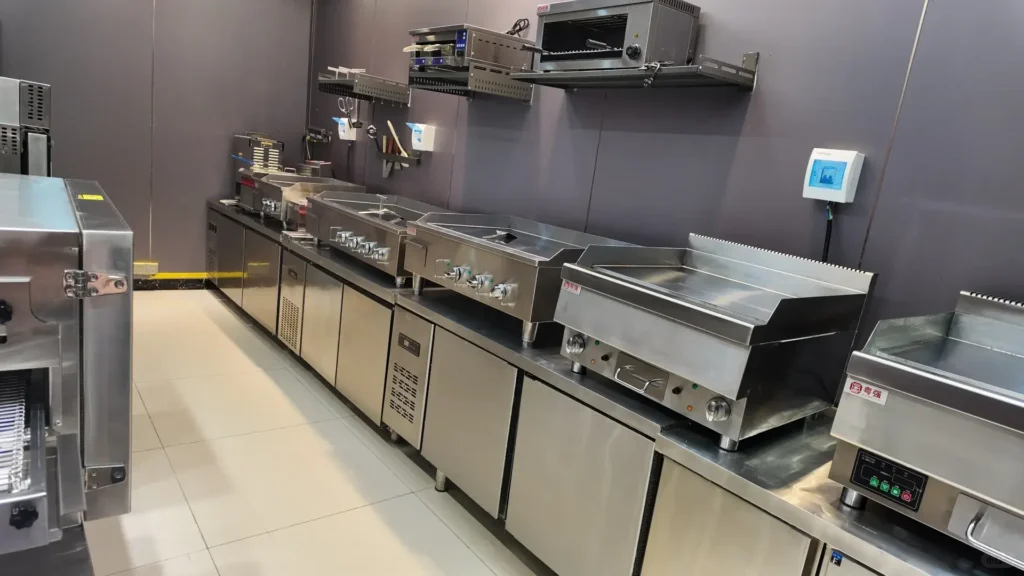
| Cooking | Fryer; griddle; charbroiler; oven; toaster; steamer | Only when required by the menu process | Peak portions, batch weight, cook and recovery time, gas/electrical load, hood classification |
| Holding/service | Hot holding cabinet; heated display; pass shelf; glass-door display chiller | Products are staged for rapid service or merchandised | Hold time, target product temperature, door/access pattern, display volume |
| Beverage/dessert | Beverage cooler; back-bar counter; ice machine; blender; dispenser | Drinks or chilled desserts are a planned sales module | Peak cups, ice demand by use, bottle/can mix, water quality, drainage |
| Cleaning/sanitation | Handwash sink; warewashing sink or machine; pre-rinse; mop sink; grease control | Required by process and local authority | Local code, water pressure/temperature, drainage, chemical program, utensil volume |
Which Equipment Modules Fit Common Snack Menus?
- Fried snacks or chicken: freezer or chiller, breading/prep area, fryer sized by recovery output, oil filtration if justified, hot holding, and code-compliant exhaust and fire protection.
- Burgers, wraps, or sandwiches: refrigerated prep table, undercounter backup storage, griddle/charbroiler or sandwich press, toaster if needed, pass, and cold beverage storage.
- Pizza or baked snacks: dough or ingredient prep, mixer only if production requires it, oven matched to product and peak cycle, refrigerated ingredient storage, and a hot display only when hold quality has been validated.
- Cold snacks, salads, and desserts: food-grade refrigeration, protected ingredient pans, portioning tools, cold display where appropriate, and strict raw/ready-to-eat separation.
How Should a Buyer Choose Commercial Refrigeration?
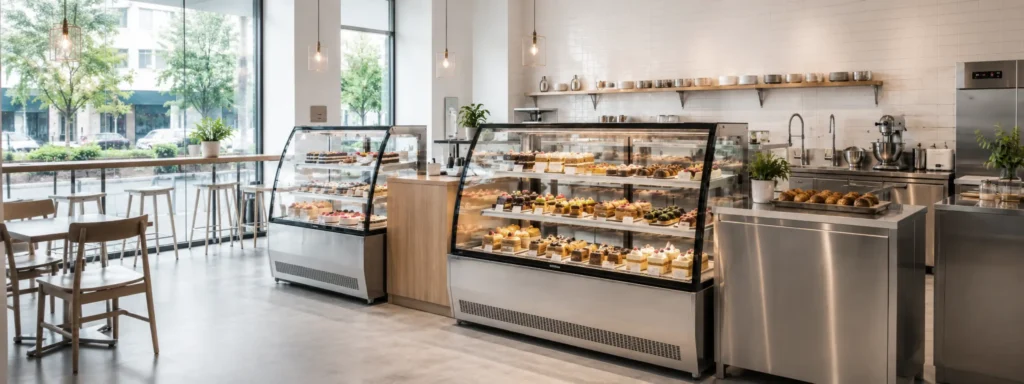
Choose refrigeration by task, food-safety duty, ambient conditions, and access pattern. A display chiller, prep table, undercounter refrigerator, and storage refrigerator solve different problems even when their cabinet volumes look similar.
| Refrigeration type | Best use | Critical checks | Avoid when |
| Solid-door reach-in | Back-of-house food storage | Food-grade temperature duty, usable shelf layout, door recovery, rated ambient, kWh/day | Frequent line access creates long staff travel or door-open time |
| Undercounter refrigerator | Sealed backup stock at the point of use | Worktop load, compressor location, service access, door/drawer layout | Open ingredient pans are needed during assembly |
| Refrigerated prep table | Protected chilled pans plus work surface | Pan format, pan depth, hood/cover, airflow around pans, overnight storage rules | The operation only needs packaged or sealed storage |
| Glass-door display chiller | Merchandising packaged drinks or qualified foods | Food-grade rating, product temperature, condensation control, lighting heat, door type, shelf load | The unit is beverage-only or cannot hold TCS food under real ambient load |
| Freezer | Frozen stock or menu-specific frozen holding | Storage temperature, pull-down/recovery, defrost method, door openings, ambient rating | A refrigerator is being expected to freeze warm product |
Set food-safety performance before cabinet temperature
The 2022 FDA Food Code is a model code, not a universal local law. It specifies cold holding of time/temperature control for safety (TCS) food at 5°C (41°F) or less and hot holding at 57°C (135°F) or above, subject to stated exceptions. It also requires cooked TCS food to cool from 57°C to 21°C (135°F to 70°F) within 2 hours and to 5°C (41°F) or less within 6 hours total. Local regulations always control. [1]
Buyer implication:A storage refrigerator is not automatically a rapid-cooling machine. If the process requires cooling cooked batches, validate a documented cooling method or specify a suitable rapid pull-down/blast chilling solution.
NSF/ANSI 7 covers sanitation and food-protection requirements for commercial refrigerators and freezers, including reach-ins, undercounters, prep units, display refrigerators, and beverage coolers. Ask for model-specific evidence accepted in the destination market; a logo in a general catalog is not proof for the quoted model. [2]
Check ambient temperature, airflow, and the door pattern
High kitchen heat, humidity, dust, tight condenser clearances, direct sunlight, and repeated door openings increase the load on refrigeration. Give the supplier the expected maximum room temperature and humidity, planned clearance, installation location, door-opening pattern, and product loading temperature. Require the quotation to state the rated ambient condition and test basis.
Plan Layout, Utilities, and Ventilation Before Ordering
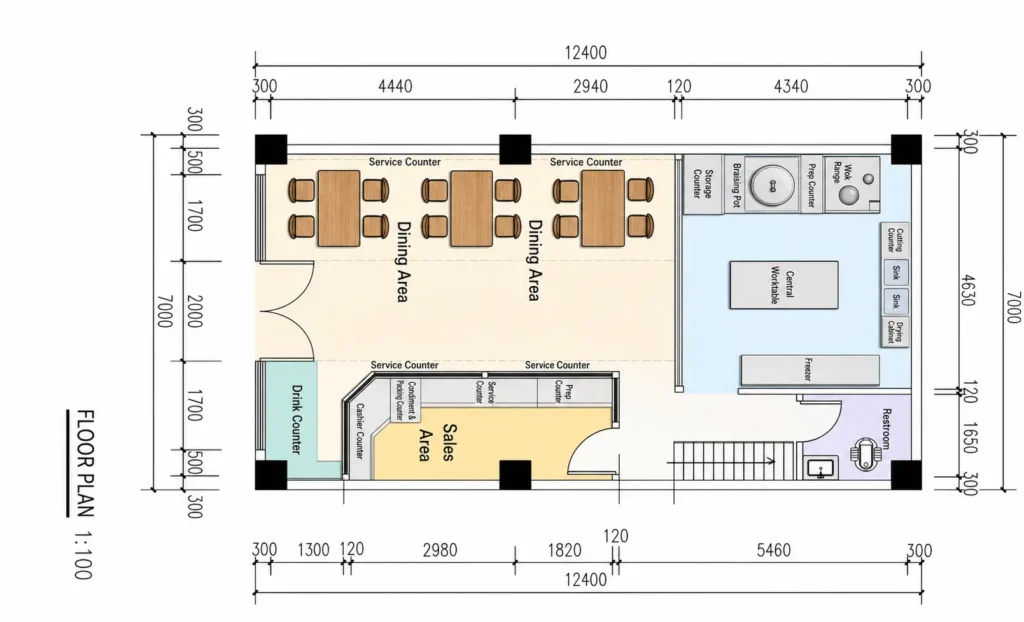
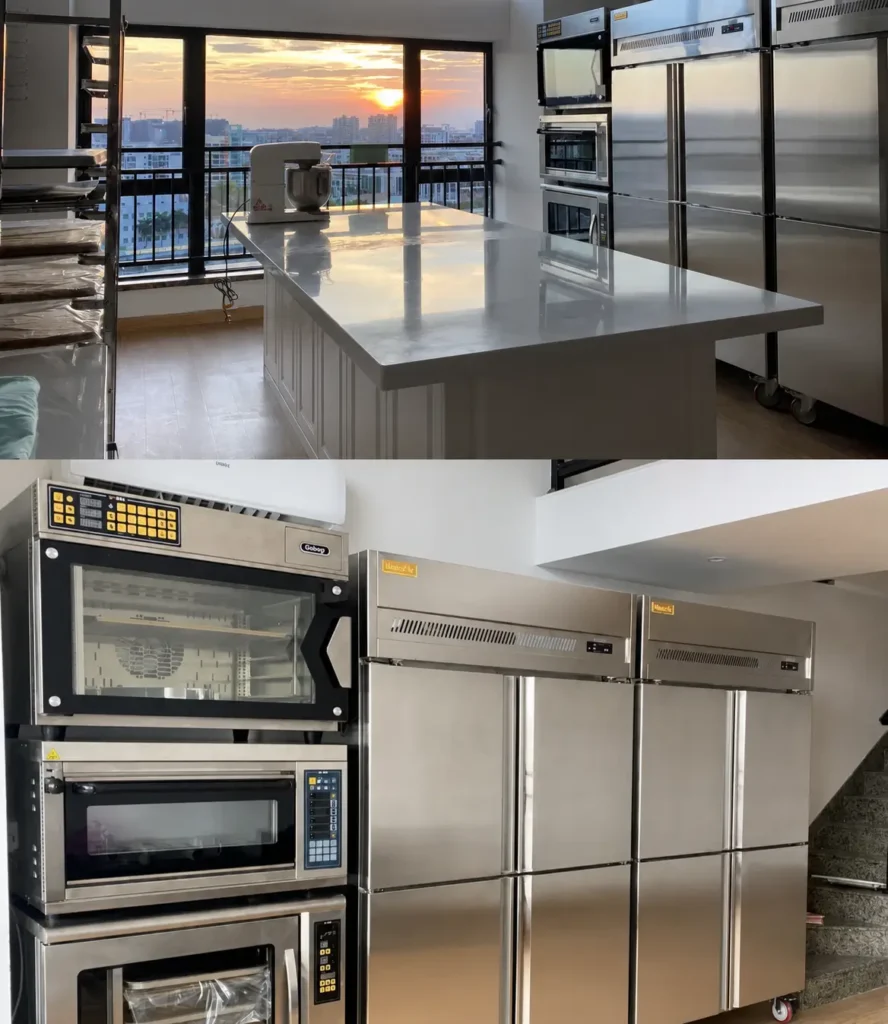
Freeze the equipment schedule only after the menu flow and building services agree. A practical one-way sequence is receiving to storage to prep to cooking to holding/service to warewashing, with raw and ready-to-eat paths separated where required.
| Project input | Record before RFQ | Why it changes selection |
| Space and access | Equipment footprint, service clearance, door swing, aisle, delivery route, lift/door limits | A cabinet can fit the plan but fail the delivery route or block maintenance |
| Electrical | Voltage, frequency, phase, available breaker capacity, plug or terminal requirement | Motors, heaters, controls, and compressor performance must match the site supply |
| Gas/water/drain | Fuel type and pressure; water quality/pressure; floor or indirect drain positions | Cooking, ice, beverage, and warewashing equipment may need dedicated services |
| Ventilation | Appliance duty, hood type, exhaust, replacement air, fire-suppression interface | Cooking heat and effluent affect safety, comfort, and refrigeration load |
| Environment | Maximum ambient temperature/humidity, dust/grease exposure, sunlight, altitude if relevant | Rated conditions determine whether performance claims are applicable |
ASHRAE Standard 154 provides design criteria for commercial cooking ventilation systems covering kitchen hoods, exhaust systems, and replacement air systems. Exact exhaust, make-up air, and fire-suppression requirements remain project- and jurisdiction-dependent. [4]
How Do You Compare Supplier Quotes and Total Cost?
Make suppliers answer the same model-level data sheet. Compare delivered performance and lifecycle obligations, not only the cabinet description or purchase price.
| Comparison field | Required evidence or answer | Red flag |
| Identity and performance | Exact model, dated data sheet, dimensions, net volume, temperature range, rated ambient, cooling method | Generic brochure or missing test conditions |
| Utilities | Voltage/frequency/phase, rated power/current, plug/terminal, gas/water/drain needs | Quote changes utility data after order |
| Refrigeration | Refrigerant and charge, compressor location, defrost, condenser access, kWh/day and test method where available | Efficiency claim without measured consumption |
| Construction | Door/glass type, shelf count/load, pan configuration, insulation, casters/feet, lighting | Options listed without a confirmed bill of materials |
| Compliance | Model-level certificates/listings required by the destination market | Company-level claim presented as product certification |
| Delivery and support | Packing size/weight, loading plan, manuals, wiring diagram, parts list, service contacts, spare-parts proposal | No documentation or service-access plan |
Calculate a simple lifecycle comparison
Use supplier data and your local costs. Annual refrigeration energy cost equals measured kWh/day multiplied by operating days/year and the local electricity tariff. A simple five-year total cost adds delivered equipment, installation, energy, planned maintenance, and spare parts, then subtracts expected residual value.
For context, ENERGY STAR states that certified commercial refrigerators and freezers are, on average, 20% more energy efficient than standard models. That is a U.S. program comparison, not a claim that any PURUI model is certified. If certification is offered, verify the exact model listing. [3]
Use a Buyer Checklist From RFQ to Commissioning
A complete purchase file should connect the operational need to the final accepted equipment. Use the following sequence for a new shop, chain rollout, distributor order, or project tender.
- Define the menu, peak 15-minute demand, portion size, batch process, hold time, delivery schedule, and cleaning method.
- Issue a dimensioned layout and utility schedule, including ambient conditions, access route, service clearances, and local compliance requirements.
- Request exact model data, option codes, drawings, certificates/listings, manuals, packing details, spare-parts list, and model-level energy data where available.
- Approve a final technical schedule before commercial acceptance. Price, MOQ, payment terms, EXW/FOB basis, lead time, warranty, discount, and stock status require manual confirmation.
- At delivery, inspect packaging and serial/nameplate data against the approved schedule before installation. Follow the manufacturer manual for handling and start-up.
- Commission under realistic load: verify product temperatures with calibrated instruments, door recovery, drainage, controls, lighting, noise/vibration, and staff cleaning access. Record acceptance results.
What Can PURUI Support for a Fast Food or Snack Project?
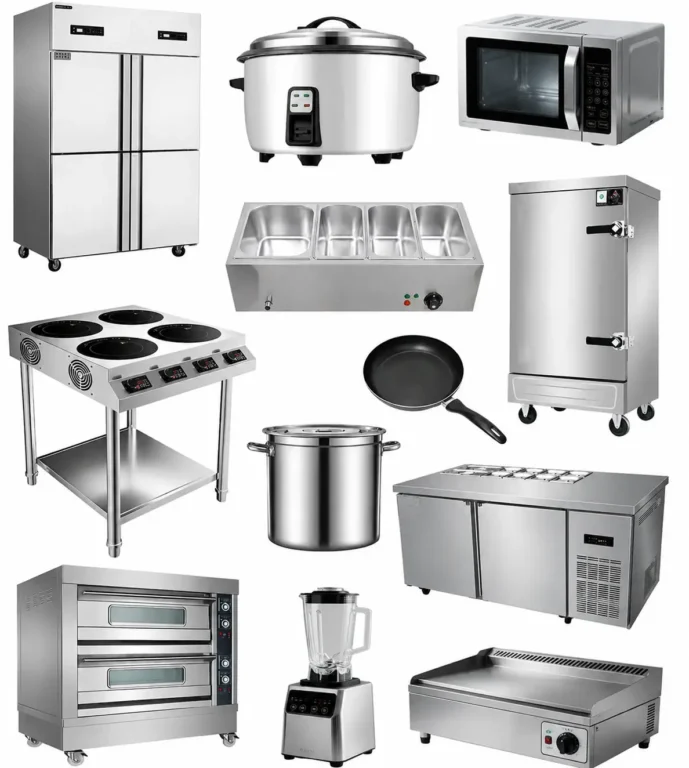
PURUI / PURUI-PRECISION can support commercial refrigeration and beverage-bar equipment selection, OEM/ODM discussion, and project matching based on confirmed specifications and application scenarios. Potential customization may include structure, color, light box, cabinet stickers, refrigeration method, shelves, casters, and built-in light color when confirmed by the factory.
PURUI confirmation boundary:For every proposed model, dimensions, capacity, temperature range, voltage/frequency, power, refrigerant, cooling type, compressor location, MOQ, EXW/FOB price, lead time, warranty, packaging, and 40HQ loading quantity are information missing / needs confirmation until a project-specific technical and commercial offer is issued.
For model selection or quotation guidance, send PURUI the menu, peak output, required food and beverage temperatures, site ambient conditions, installation dimensions, destination country, voltage/frequency/phase, preferred door and shelf configuration, customization scope, and estimated order quantity. Final commercial terms require manual confirmation.
Frequently Asked Questions
What equipment is essential for a small snack shop?
Start with the process, not the shop size. Most small snack shops need commercial cold storage, a prep surface, only the cooking appliances used by the core menu, safe hot or cold holding where required, handwashing and warewashing facilities, dry storage, ventilation/fire controls where applicable, and a service/POS area. Add specialty equipment only after peak-demand calculations show a need.
How do I size a refrigerator for a fast food shop?
Size refrigeration from containers and deliveries, not from floor area alone. Count station pans, sealed backup stock, case-pack dimensions, delivery frequency, food-separation needs, and maximum incoming product temperature. Then verify usable shelf space, rated ambient condition, door-opening recovery, and model-level energy consumption. Keep a documented contingency rather than applying an unverified universal percentage.
Can a glass-door display chiller store food ingredients?
Only if the exact model is rated and approved for that food-safety duty. Confirm that it can keep the required product temperature under the real ambient temperature, humidity, loading, and door-opening pattern. Beverage-only coolers should not be assumed suitable for TCS food. Check the data sheet, model listing/certificate, and destination-market rules.
Should I buy an undercounter refrigerator or a prep table?
Choose an undercounter refrigerator for sealed stock close to the workstation; choose a refrigerated prep table when protected chilled pans and a work surface are both needed. Compare pan format, airflow around open pans, backup storage, compressor location, service access, and overnight storage procedure. A prep table is not automatically better if the menu uses packaged ingredients only.
What specifications should an importer confirm before ordering?
Confirm the exact model, dimensions, temperature duty, rated ambient, voltage/frequency/phase, power/current, refrigerant and charge, cooling and defrost method, compressor location, construction, door/glass, shelves/pans, casters, certificates/listings, manuals, packing size/weight, spare parts, service route, MOQ, commercial basis, lead time, and warranty. Unconfirmed values should be marked information missing / needs confirmation.
How should I compare equipment prices from different suppliers?
Compare equivalent delivered scope and five-year cost, not the headline price. Normalize freight, duties, installation, energy use, planned maintenance, spare parts, service access, downtime risk, documentation, and compliance evidence. Use measured kWh/day with its test method where available. PURUI price, MOQ, payment, lead time, discount, stock, and warranty require manual confirmation.
Decision Summary
Choose a compact station-based package when the menu is narrow and deliveries are frequent. Add prep-table capacity, freezer storage, or hot holding only when peak demand and hold-quality tests justify them. Upgrade ambient-duty refrigeration, ventilation, and service access when the site is hot, humid, dusty, or difficult to maintain. The conditions that most often change the final choice are peak 15-minute output, rated ambient, utilities, local code, and after-sales support.
Next step:Send PURUI a menu and site data sheet for model selection, OEM/ODM discussion, project matching, and quotation guidance. A factory-confirmed technical schedule should be approved before final commercial terms are accepted.
External Authority Sources Used
[1] U.S. Food and Drug Administration – 2022 Food Code –Open official source page. Model cold/hot holding and cooling time-temperature provisions; local law controls.
[2] NSF – Food Equipment Standards –Open official resource page. NSF/ANSI 7 applies to commercial refrigerators, freezers, prep units, displays, and beverage coolers.
[3] ASHRAE – Standards Titles, Purposes, and Scopes –Open official resource page. Scope of ANSI/ASHRAE Standard 154 for kitchen hoods, exhaust, and replacement air.
Explore PURUI Fast Food Restaurant Equipment
Looking for reliable equipment for a fast food restaurant, snack shop, takeaway outlet, or foodservice project? PURUI supplies commercial refrigeration and kitchen equipment designed to support efficient food preparation, safe storage, smooth service flow, and flexible kitchen layouts. Available configurations can be matched to different menus, spaces, and operating needs, with OEM/ODM options subject to factory confirmation.
Contact PURUI Today
Looking for reliable commercial refrigeration equipment or customized solutions?
Whether you need standard products or small-scale OEM projects, PURUI can help you build the right refrigeration solution for your business
Products
Choose PURUI Commercial Display Refrigerators to Support Your Business Growth
Projects
Explore PURUI Completed Projects and equipment solutions
Contact Us
Contact PURUI for Project Consultation