SUPERMARKET REFRIGERATION GUIDE
How We Plan a Supermarket Refrigeration System: Equipment, Energy, Refrigerants and Total Cost
A practical PURUI guide for supermarkets, grocery stores, convenience stores, importers and project contractors
At PURUI, we plan supermarket refrigeration as one coordinated system. We select display cases, cold rooms, condensing capacity and controls from product temperature, display length, store climate, peak load, refrigerant rules and lifetime cost, then verify drainage, service access and operating performance under the project’s actual site conditions.
What Do We Prioritize First in a Supermarket Refrigeration Project?
| Decision | Minimum data required | What the final submittal should show |
| Food safety | Product type and legal holding temperature | Product temperature range, case class and sensor locations |
| Capacity | Display length, cold-room volume, loading and site climate | Cooling duty at stated ambient and evaporating conditions |
| Energy | Declared kWh/24h or system power profile | Annual kWh, peak kW, tariff assumptions and heat-recovery credit |
| Refrigerant | Target country, GWP rules, charge and local service capability | Refrigerant, GWP, charge, safety class and compliance evidence |
| Reliability | Operating hours, redundancy requirement and service response | Alarm plan, isolation strategy, spare-parts list and commissioning criteria |
At PURUI, we treat energy performance as a core design input. ENERGY STAR states that refrigeration may use up to 40% of a supermarket or grocery store’s total property energy, so we evaluate each cabinet as an operating-cost and food-risk decision, not only a merchandising choice. ENERGY STAR grocery-store guidance
What Do We Include in a Complete Supermarket Refrigeration Solution?
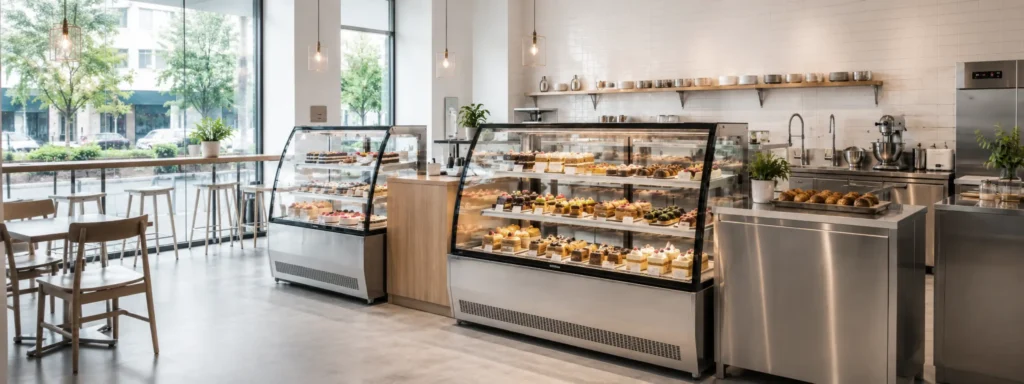
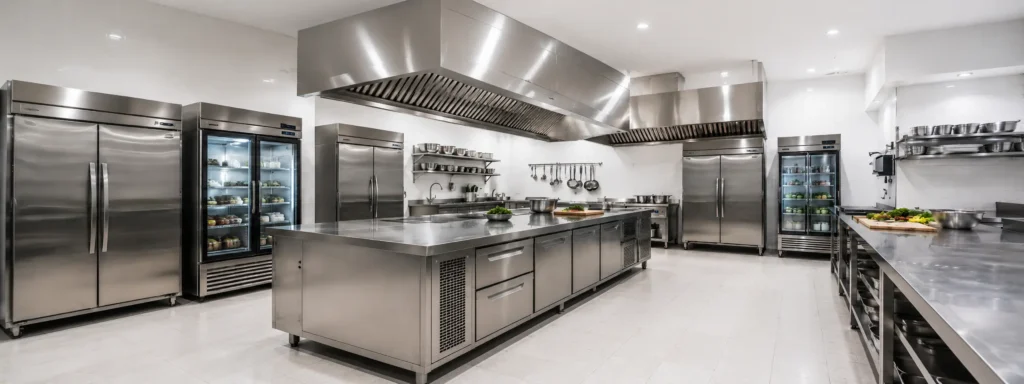
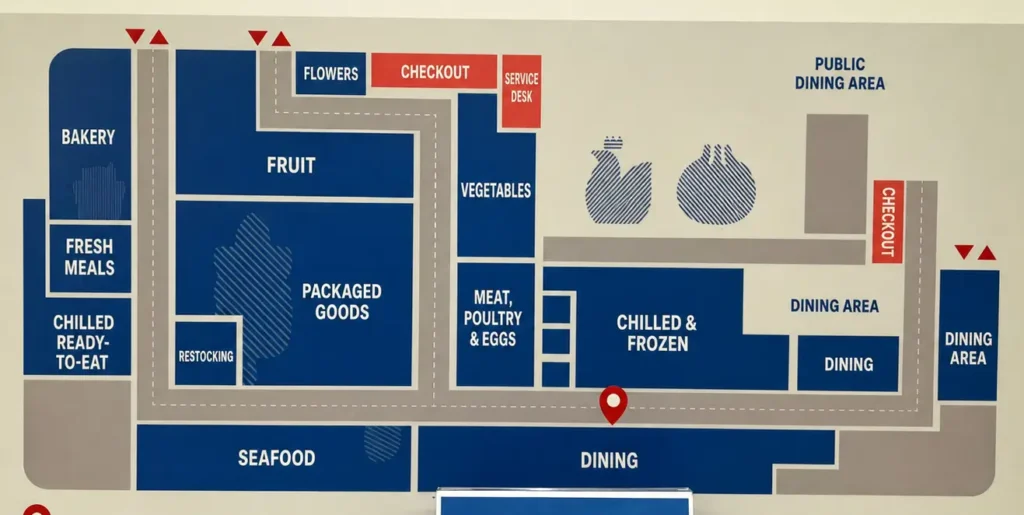
We begin every complete solution with a merchandising and food-temperature map. We then connect each display and storage zone to the refrigeration architecture, utilities, controls and service plan. Our schedule distinguishes display-only equipment from food-zone storage equipment and identifies whether products enter pre-chilled, frozen or as a defined pull-down load.
Which Refrigeration Zones Do We Map First?
| Store zone | Typical equipment | Primary design question |
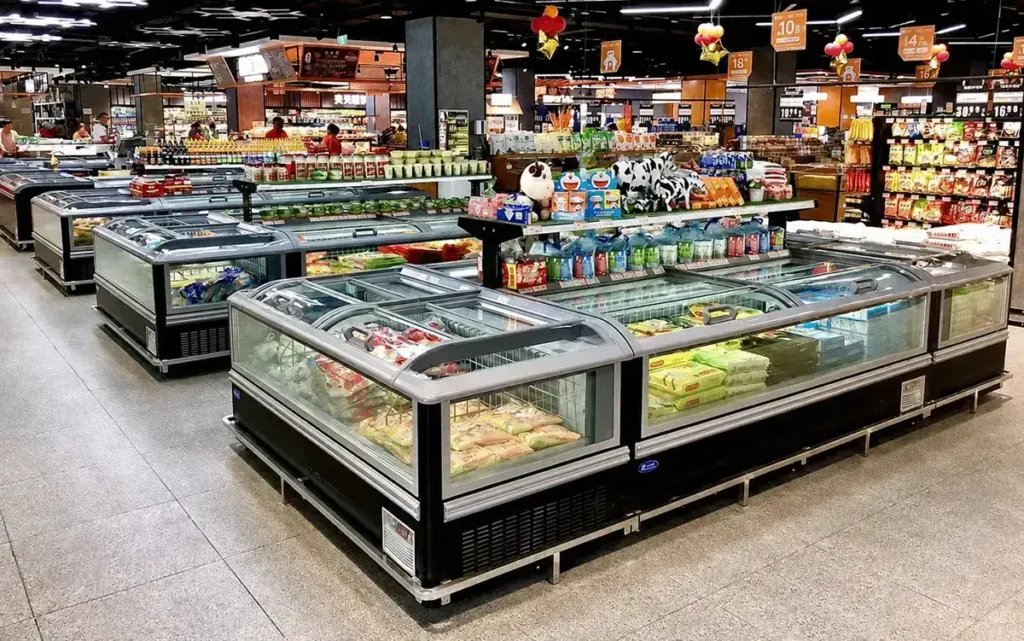
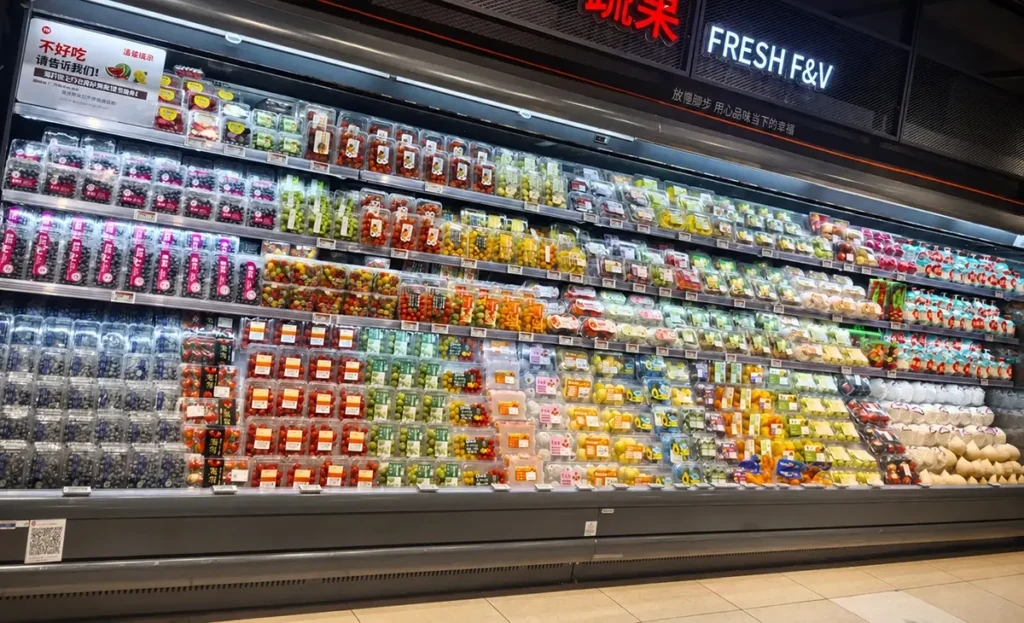
| Produce and grab-and-go | Open or glass-door multidecks, island displays | Can product temperature remain stable under traffic and ambient airflow? |
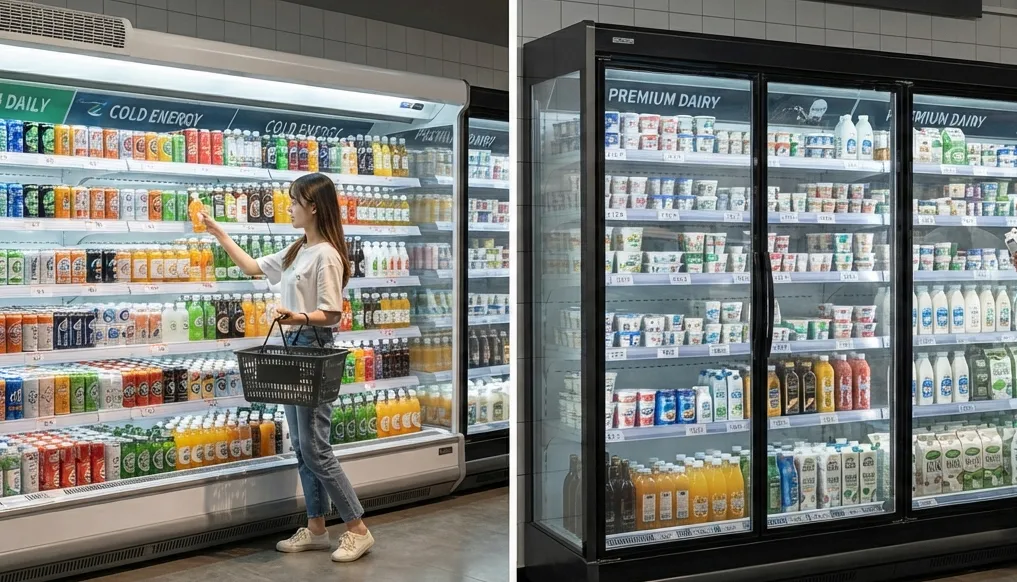
| Dairy and beverages | Glass-door multidecks and upright merchandisers | Is display density balanced with door access and replenishment? |
| Meat, deli and prepared food | Service counters, multidecks, refrigerated prep/storage | Is the cabinet approved for packaged or open food as applicable? |
| Frozen food and ice cream | Vertical glass-door freezers, island freezers | Can low temperature recover after openings and defrost? |
| Back-of-house reserve | Walk-in cold rooms and freezer rooms | Is reserve stock separated from high-value sales-floor space? |
| Receiving and staging | Ante-room, temporary cold holding or rapid pull-down equipment | How long can incoming product remain outside controlled storage? |
When we select sales-floor equipment, we first confirm whether it will hold packaged, sealed goods or open food. We also treat air-curtain merchandisers as holding equipment for already cold products, not as equipment for cooling warm incoming stock. WebstaurantStore refrigerated merchandiser guide
When Do We Recommend Self-Contained, Remote or Centralized Refrigeration?
| Architecture | Best-fit conditions | Trade-offs to verify |
| Self-contained cabinets | Smaller projects, phased installation, limited refrigerant piping | Heat and sound may enter the sales area; each unit needs power, airflow and service access |
| Remote condensing units | Several cabinets or cold rooms with condensers located away from customers | More field piping and refrigerant management; confirm line sizing and ambient capacity |
| Central pack or rack | Larger stores with many medium- and low-temperature loads | High integration and heat-recovery potential; requires specialist design, controls and service |
| Distributed, secondary or cascade system | Projects prioritizing charge reduction, zoning or refrigerant separation | Pumps or heat exchangers add complexity; compare energy, charge and technician capability |
| Transcritical CO2 system | Projects where natural refrigerant, integrated controls and heat recovery fit the market | High-pressure design, climate strategy, controls and trained service are essential |
We compare system architectures instead of assuming one layout fits every store. Centralized DX, distributed DX, cascade CO2, secondary and booster CO2 systems differ in refrigerant charge, leakage exposure, pumping, heat-exchanger losses, controls, energy behavior and local service requirements. Copeland supermarket system descriptions
How Do We Calculate Supermarket Refrigeration Capacity?
We calculate capacity from coincident peak loads, not from cabinet volume alone. We state the design indoor and outdoor conditions, product temperatures, operating schedule and diversity assumptions. The same cabinet can require different system capacity in a humid tropical entrance zone than in a climate-controlled aisle.
Which Load Components Do We Include?
- Cabinet and cold-room transmission: heat passing through insulated panels, glazing, doors, floors and ceilings.
- Infiltration: warm, humid air entering open cases, cold rooms or cabinets during door openings and through disrupted air curtains.
- Product load: heat removed from incoming product, packaging and stocking carts; this is separate from steady holding load.
- Internal load: evaporator fans, anti-sweat heaters, lights, people and other electrical components inside the refrigerated envelope.
- Defrost and recovery: heat added during electric, hot-gas or off-cycle defrost and the capacity needed to recover afterward.
- Piping and system effects: suction-line gains, liquid conditions, pressure drop, heat exchangers and control strategy.
- Operating reserve: a documented margin for uncertainty and planned expansion, not a substitute for missing load data.
We give infiltration special attention. DOE reports that open vertical medium-temperature cases make up nearly 50% of the case lineup in a typical supermarket and that more than 80% of their cooling load can be attributed to surrounding-air infiltration. U.S. DOE display-case project
How Do We Adjust for Site Climate and Cabinet Placement?
When we review site climate, we check the selected model’s certified limits and the local airflow around it. WebstaurantStore reports a common manufacturer placement limit for open air-curtain merchandisers of 75°F (about 24°C) and 55% relative humidity and advises against HVAC vents, fans, doors and direct sunlight. WebstaurantStore placement guidance
We do not treat laboratory duty as a universal site value. In an IIR study of two stores, climate class 3 was useful for pack sizing, but the researchers proposed field reduction factors of 0.8 to 0.9 for the open vertical cabinets studied. We use this as evidence that site correction matters, not as a universal coefficient. IIR supermarket cabinet energy study
What Do We Put in a Refrigeration Capacity Schedule?
| Required field | Example entry format |
| Cabinet or room ID | Dairy-MD-01 / Frozen-IS-02 / Cold-Room-MT-01 |
| Operating temperature | Declared product temperature class or target product range |
| Design climate | 25°C / 60% RH indoors; 38°C outdoor condensing design |
| Rated cooling duty | W per cabinet or W/m at the stated test condition |
| Connected electrical load | Compressor, fans, lights, heaters and defrost listed separately |
| Peak-use assumption | Door openings, stocking period, defrost concurrency and product load |
| Correction and diversity | Each factor named and justified |
| Selected capacity | Net available capacity at design suction and ambient conditions |
Our calculation is project-specific. For illustration, if scheduled coincident loads total 72 kW and an approved engineering reserve is 10%, we would require at least 79.2 kW of net capacity at the stated design condition (72 x 1.10). We do not treat 10% as a universal margin; load diversity, expansion and actual-condition capacity must be confirmed.
How Do We Compare Energy Use and Total Cost?
Which Energy Metrics Do We Use?
For self-contained sales cabinets in the EU, we use the energy label and product information sheet instead of an unsupported ‘energy-saving’ claim. The label reports efficiency class, energy consumption, compartment volume or display area and compartment temperature; beverage coolers and ice-cream freezers also show maximum ambient temperature. European Commission commercial refrigerator guidance
EU Regulation 2019/2024 defines daily energy consumption as the energy used over 24 hours at reference conditions and annual energy consumption as daily energy multiplied by 365. In the United States, covered commercial refrigeration equipment must use the DOE test procedure in 10 CFR 431.64 and meet the standards in 10 CFR 431.66. EU Ecodesign Regulation 2019/2024; U.S. DOE commercial refrigeration equipment
We do not compare a remote cabinet’s cooling duty with a self-contained cabinet’s total electrical consumption. For remote systems, we calculate compressor-rack, condenser or gas-cooler, pump, fan, heater, defrost and control energy across the same boundary and state that boundary above the comparison.
When Do We Recommend Doors Instead of an Open Display Case?
We generally recommend doors when energy control and temperature stability outweigh unrestricted access, but we verify each cabinet and store. In one IIR test, retrofitting doors reduced the tested cabinet’s energy consumption to 51.5% of the open-cabinet value while improving its temperature span; this is evidence, not a guaranteed saving for every project. IIR door-retrofit study
We also measure the commercial trade-off: product visibility, door-opening time, aisle width, replenishment labor, condensation control and shopper behavior. Night curtains can help open cases during closed hours, but we do not treat them as equivalent to doors throughout trading hours.
How Do We Calculate Lifecycle Cost?
We use one ownership period and one calculation boundary for every option:
TCO = equipment + freight + installation + electrical/plumbing/building work + lifetime energy + preventive maintenance + repairs + refrigerant loss + expected downtime/food loss – heat-recovery value – residual value
For example, if we compare Option A at 18 kWh/24h with Option B at 12 kWh/24h under the same declared conditions, the difference is 2,190 kWh/year: (18 – 12) x 365. At an illustrative tariff of USD 0.15/kWh, Option B saves USD 328.50/year or USD 3,285 over 10 years before escalation, maintenance or financing. We replace every example input with the project value.
How Do We Select a Refrigerant Strategy?
We do not select a refrigerant by GWP alone. We evaluate target-market law, system size, temperature level, climate, safety code, charge limit, installation location and local technician competence. Energy efficiency, lifetime leakage, serviceability and compliance can outweigh a simple comparison of refrigerant GWP.
What Do We Check Beyond Refrigerant GWP?
- Legal availability: current placing-on-market, installation and service restrictions in the destination country.
- Safety class and charge: flammability, toxicity, pressure, occupied-space limits, ventilation, detection and emergency procedures.
- Climate performance: capacity and efficiency at the actual outdoor and indoor design conditions.
- System architecture: self-contained R290, remote low-GWP HFO/HFC blends, secondary systems or CO2 may fit different project scales.
- Service ecosystem: technician training, recovery tools, high-pressure tools, spare parts and refrigerant availability.
- Total carbon impact: electricity emissions plus refrigerant charge, annual leakage and end-of-life recovery.
We quantify leakage as a design and operating input. EPA GreenChill states that a typical food retail store refrigeration system leaks about one quarter of its refrigerant charge each year. We therefore request expected leakage in kg/year and convert it to CO2-equivalent exposure instead of hiding it inside maintenance cost. EPA GreenChill Store Certification
Illustrative emissions calculation: refrigerant charge x annual leak rate x refrigerant GWP = annual direct emissions. A 100 kg system leaking 10% per year with a GWP of 1,300 would equal 13,000 kgCO2e/year. This is an arithmetic example, not a PURUI product specification or a forecast for every system.
How Do Current EU and U.S. Rules Affect Equipment Selection?
European Union: Regulation (EU) 2024/573 prohibits, subject to listed exceptions, placing self-contained refrigeration equipment other than chillers on the market when it contains fluorinated greenhouse gases with GWP of 150 or more from 1 January 2025. The regulation also addresses multipack centralized commercial refrigeration systems rated at 40 kW or more and other stationary equipment on separate timelines. Regulation (EU) 2024/573
United States: EPA’s current sector table lists a GWP limit of 150 for retail-food refrigeration stand-alone units from 1 January 2025, while other retail-food subsectors have their own limits, dates and equipment definitions. DOE separately regulates covered equipment energy testing and standards. Confirm the current EPA and DOE requirements for the exact model at the time of order because rule details and implementation dates can change. EPA Technology Transitions HFC restrictions; DOE commercial refrigeration equipment
For other markets, we ask the RFQ to name the required electrical, sanitation, pressure-equipment, refrigerant, safety and energy certifications. We never assume CE, UL, ETL, NSF or another mark from a generic product photo; we verify certification at model level.
How Do We Use Smart Controls and Heat Recovery?
Which Operating Points Do We Monitor?
| Measurement | Operational use | Recommended KPI |
| Case and product-simulation temperatures | Food-safety verification and temperature stability | % time in range; warmest point; recovery time |
| Suction/discharge or CO2 system pressures | Capacity control and fault diagnosis | Pressure stability; high-pressure events |
| Compressor current and runtime | Load staging and mechanical health | Runtime balance; starts/hour; peak kW |
| Door, defrost and heater status | Explain temperature and energy events | Open duration; defrost duration; heater hours |
| Ambient temperature and RH | Normalize cabinet performance | Daily and seasonal exposure by zone |
| Energy meters | Verify savings and detect drift | kWh/day, kWh/m display/day and peak demand |
| Refrigerant service records | Track leakage and recurring faults | kg added/year; leak rate; repeat location |
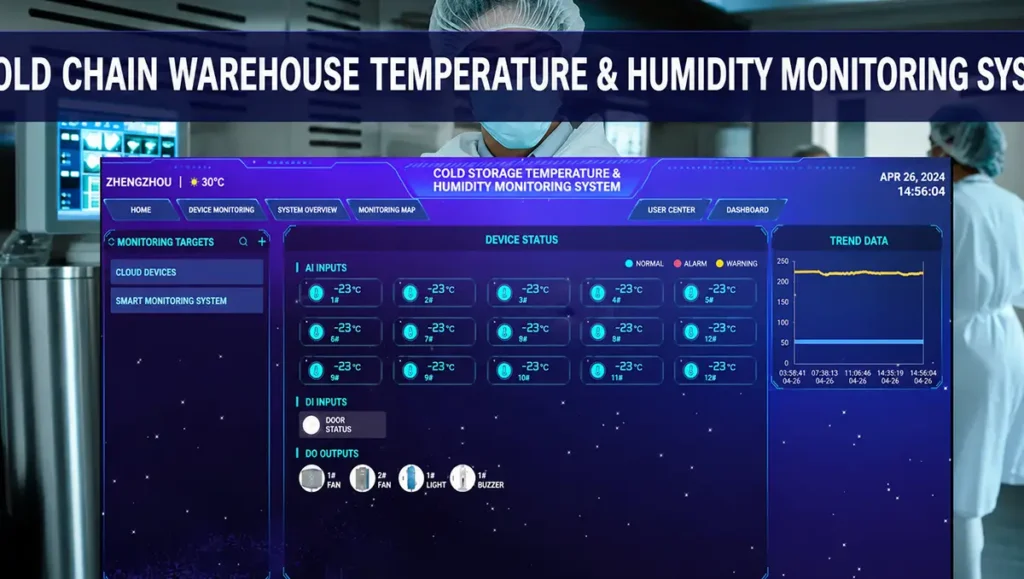
| Alarm workflow | Reduce response time and food loss | Acknowledgement time; resolution time; repeat alarms |
| Recovered heat | Value integration with space or water heating | Useful heat kWh and avoided heating cost |
What Can We Learn from the Danfoss Smart Store Case?
We use the Danfoss Nordborg case as evidence of integration potential. Its verified report states 39% avoided emissions versus a CO2 reference store and 68% versus an HFC reference store over a 15-year system life. During 2024, the store was self-sufficient in heat and exported 21.5 MWh of electricity and 23 MWh of heat; it also included a 100 kW photovoltaic array. Danfoss Smart Store avoided-emissions case study
We do not transfer those percentages directly to another project. The same report states that its results apply to the specific Nordborg store and reference scenarios and cannot be transferred directly to other locations, store types, sizes or climates. We model the destination store instead of repeating a headline percentage. Danfoss case-study scope and limitations
How Do We Verify Food Safety and Commissioning?
Why Do We Verify Product Temperature Instead of Air Temperature Alone?
We treat product temperature as the compliance outcome and air temperature as a control indicator. The 2022 FDA Food Code uses 5°C (41°F) or less as the cold-holding limit for time/temperature control for safety food, although local law and product requirements may differ. We apply the destination market’s rule and the product supplier’s storage specification. FDA Food Code 2022
We map the warmest product positions, not only the easiest sensor points, and observe door openings, stocking, defrost and recovery. For open cases, we verify loading limits and unobstructed discharge and return air. Our acceptance window identifies the product or test package, location, instrument accuracy and logging interval.
What Do We Test Before Handover?
- Installation: voltage, phase, frequency, breaker, earthing, drainage, ventilation, condenser clearance, cabinet level and door sealing.
- Refrigeration circuit: pressure test, evacuation and charging records; leak inspection; valve positions; superheat/subcooling or CO2 control values as designed.
- Temperature performance: a written 24- to 72-hour project test that includes normal stocking, door openings and at least one complete defrost/recovery cycle.
- Controls and alarms: sensor calibration, alarm thresholds, escalation contacts, remote connection, power-failure recovery and controller backup.
- Energy baseline: initial kWh/day, peak demand, compressor runtime, heater and defrost operation recorded for later comparison.
- Documentation: as-built layout, wiring and piping drawings, component list, refrigerant charge, setpoint list, manuals, spare parts and training record.
What Information Do We Need for a Supermarket Refrigeration Proposal?
To prepare a comparable proposal, we ask you to send the following project data:
- Store country, city, elevation, opening date and new-build or retrofit status.
- Dimensioned layout with ceiling height, entrances, windows, HVAC supply/return points and equipment-room location.
- Merchandising schedule: product category, display length, shelf count, access type and required product temperature.
- Cold-room schedule: internal dimensions, panel thickness, floor, doors, daily loading, incoming product temperature and traffic.
- Indoor design temperature/RH, outdoor summer and winter design temperatures and any direct-sun exposure.
- Voltage, phase, frequency, maximum available power, drainage and water availability.
- Required refrigerant strategy, GWP limit, safety or certification rules and local technician capability.
- Operating hours, night-cover plan, expected door-opening or replenishment pattern and future expansion.
- Requested performance data: cooling duty, kWh/24h or system efficiency, noise, heat rejection, refrigerant charge and test standard.
- Project boundary: supply only, OEM/ODM, layout support, installation materials, commissioning support, training, spares and after-sales documentation.
- Acceptance criteria, warranty requirement and required document language.
How Do We Support Your Supermarket Refrigeration Project?
we support overseas B2B buyers with commercial refrigeration equipment supply, product matching, OEM/ODM and project configuration. For supermarket projects, we organize the cabinet and cold-storage schedule, check utilities and site constraints, align equipment categories with the store layout, and prepare model-level submittals for buyer review.
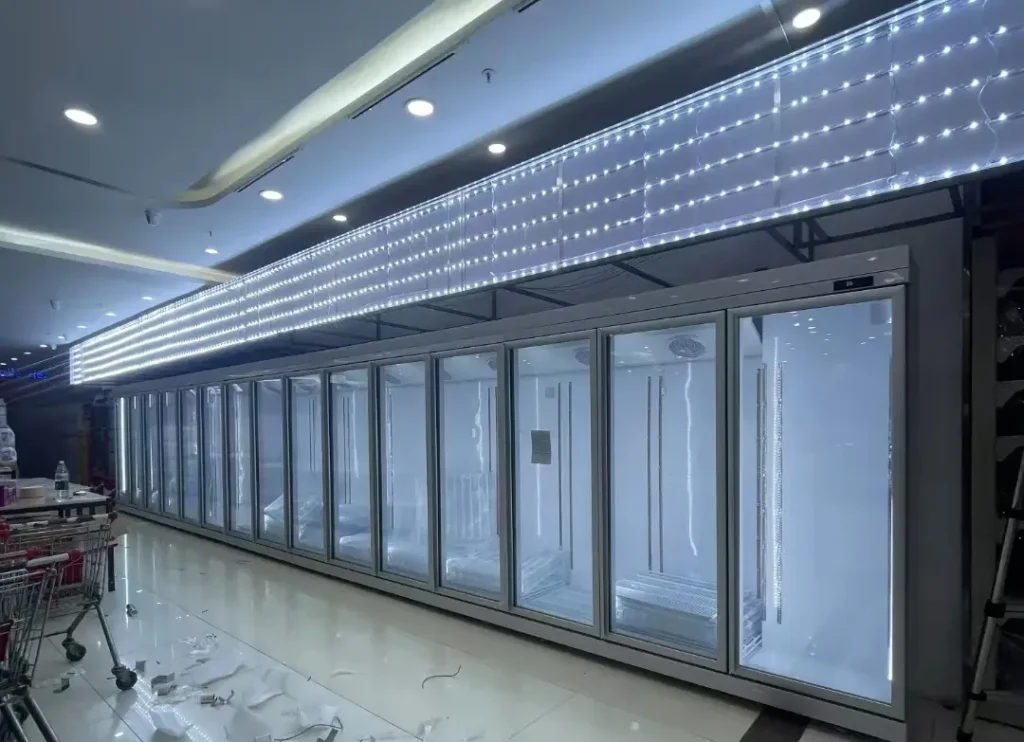
We do not treat a catalog image as an engineering submittal. Final model, dimensions, temperature range, cooling duty, power, voltage, refrigerant, certification, quantity, delivery, warranty and commercial terms must be confirmed in the project quotation and technical documents. Installation and commissioning of regulated refrigeration systems must be completed or supervised by qualified professionals in the destination market.
project input request: Send your store layout, product zones, target temperatures, city/design climate, voltage, refrigerant preference, certification requirements and supply boundary. We will use those inputs to prepare a more comparable equipment schedule and identify data that still needs confirmation.
What Are the Most Common Supermarket Refrigeration Questions?
What percentage of a supermarket’s energy is used by refrigeration?
ENERGY STAR states that refrigeration may use up to 40% of a supermarket or grocery store’s total property energy. When we assess a project, we verify the actual share through the store format, climate, case mix, doors, controls, HVAC interaction, operating hours and refrigeration submetering rather than applying 40% to every store. ENERGY STAR
How do you calculate supermarket refrigeration capacity?
We calculate the coincident peak load and select equipment at the actual design condition. We include cabinet and room transmission, infiltration, product pull-down, fans, lighting, heaters, defrost recovery, piping effects and a justified reserve, then request cooling duty at the stated climate, evaporating condition and refrigerant – not only nominal horsepower.
Are glass-door display cases more efficient than open cases?
Usually yes, because doors reduce warm-air infiltration. DOE reports that infiltration can represent more than 80% of an open vertical case’s cooling load, and one IIR test found a door-retrofitted cabinet used 51.5% of its open-case energy. We still verify cabinet design, climate, access and shopper behavior before recommending a solution. U.S. DOE; IIR study
Which refrigerant is best for a supermarket?
We do not use one refrigerant for every project. We compare legal GWP limits, climate efficiency, system size, safety class, charge, pressure, local technician skills, spare parts and total cost. R290 self-contained cabinets, low-GWP remote systems and CO2 architectures fit different project conditions, so we confirm destination-market rules before selection.
What should a smart supermarket refrigeration system monitor?
We monitor case temperatures, product-simulation points where required, system pressures, compressor runtime/current, ambient temperature/RH, doors, defrost, alarms and refrigeration energy. When applicable, we also track refrigerant service and recovered heat so the data supports food-safety verification, energy baselining and fault response – not only remote viewing.
What information should I send for a supermarket refrigeration quotation?
Please send us the dimensioned store layout, product zones, display lengths, cold-room sizes, target temperatures, city and design climate, voltage, operating hours, refrigerant/certification requirements, installation boundary and opening date. Also tell us whether you need supply only, OEM/ODM, layout support, commissioning documents, spare parts or local-installation coordination.
Which Sources Support This Guide?
- WebstaurantStore – Refrigerated Merchandisers Buying Guide
- Danfoss – Food Retail Solutions
- Danfoss – Smart Store
- Danfoss – Avoided Emissions: Smart Store Case Study
- ENERGY STAR – Energy Savings Tips for Grocery Stores
- S. Department of Energy – Grid-Interactive Refrigerated Display Case
- S. EPA GreenChill – About Store Certification
- S. FDA – Food Code 2022
- S. Department of Energy – Commercial Refrigeration Equipment
- S. EPA – Technology Transitions HFC Restrictions by Sector
- EUR-Lex – Regulation (EU) 2024/573 on Fluorinated Greenhouse Gases
- European Commission – Commercial Refrigerators and Energy Labels
- EUR-Lex – Regulation (EU) 2019/2024 on Direct-Sales Refrigerating Appliances
- International Institute of Refrigeration – Door Retrofit Display-Cabinet Study
- International Institute of Refrigeration – Supermarket Display-Cabinet Energy Study
- Copeland – Supermarket Refrigeration System Architectures
Contact PURUI Today
Looking for reliable commercial refrigeration equipment or customized solutions?
Whether you need standard products or small-scale OEM projects, PURUI can help you build the right refrigeration solution for your business
Products
Choose PURUI Commercial Display Refrigerators to Support Your Business Growth
Projects
Explore PURUI Completed Projects and equipment solutions
Contact Us
Contact PURUI for Project Consultation