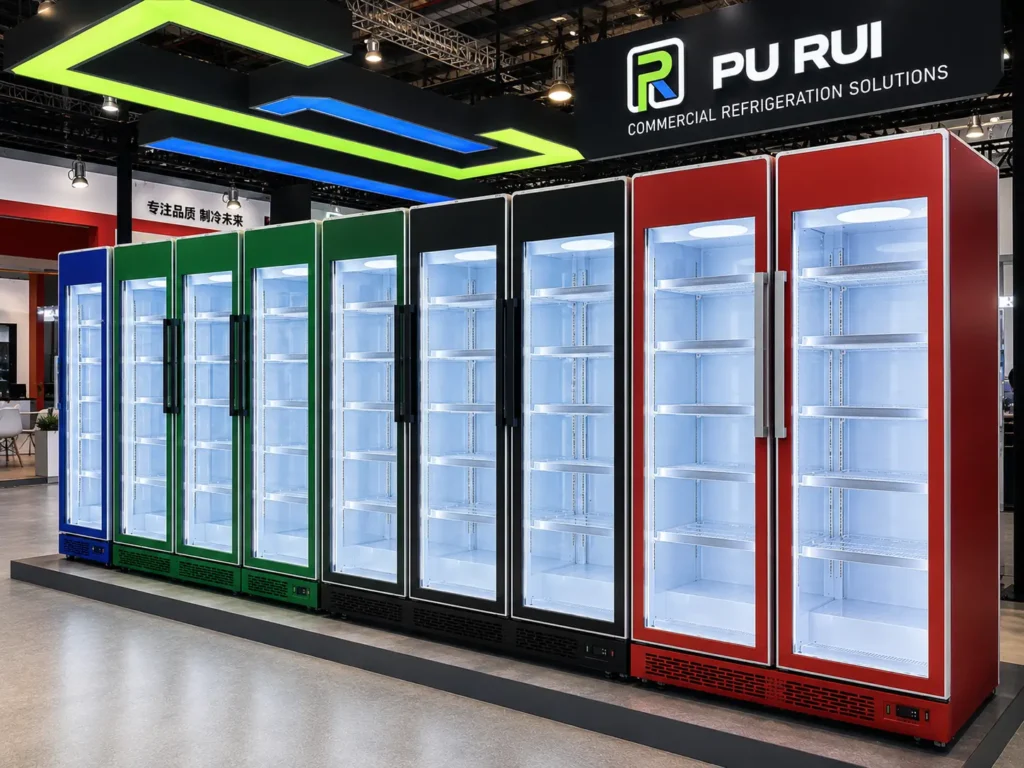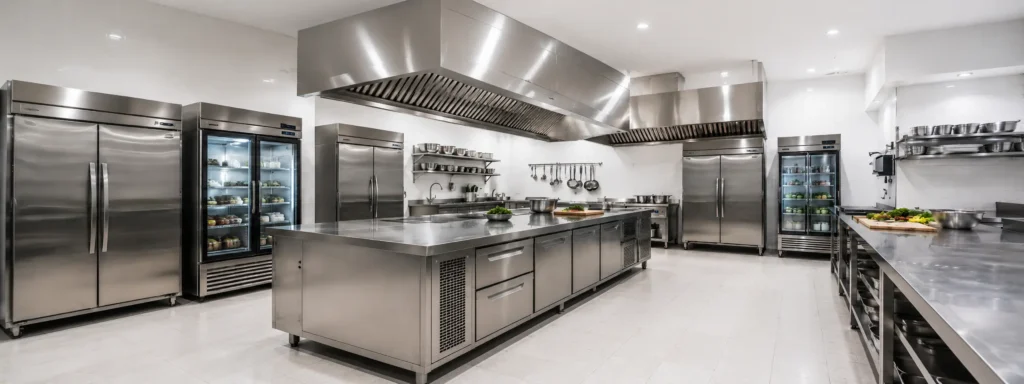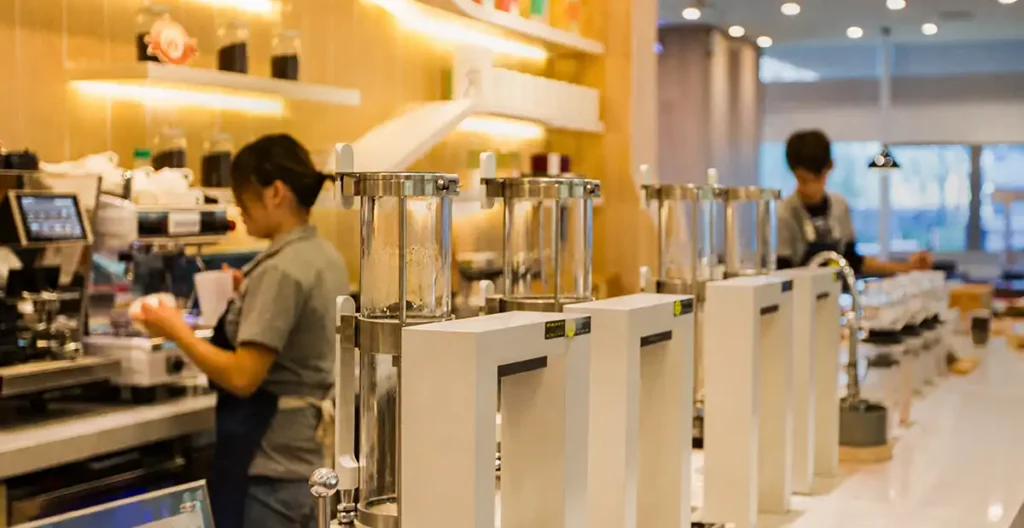
Commercial refrigeration, ice, display, stainless bar and kitchen equipment for B2B coffee shop projects
Updated: August 16, 2026
plans coffee shop equipment around the menu, peak-hour demand, available space and site utilities. We combine commercial refrigeration, ice equipment, refrigerated displays, stainless-steel bar stations, sinks and related kitchen equipment into one coordinated solution, helping distributors, importers, chains and project contractors reduce workflow bottlenecks, installation conflicts and avoidable operating costs.
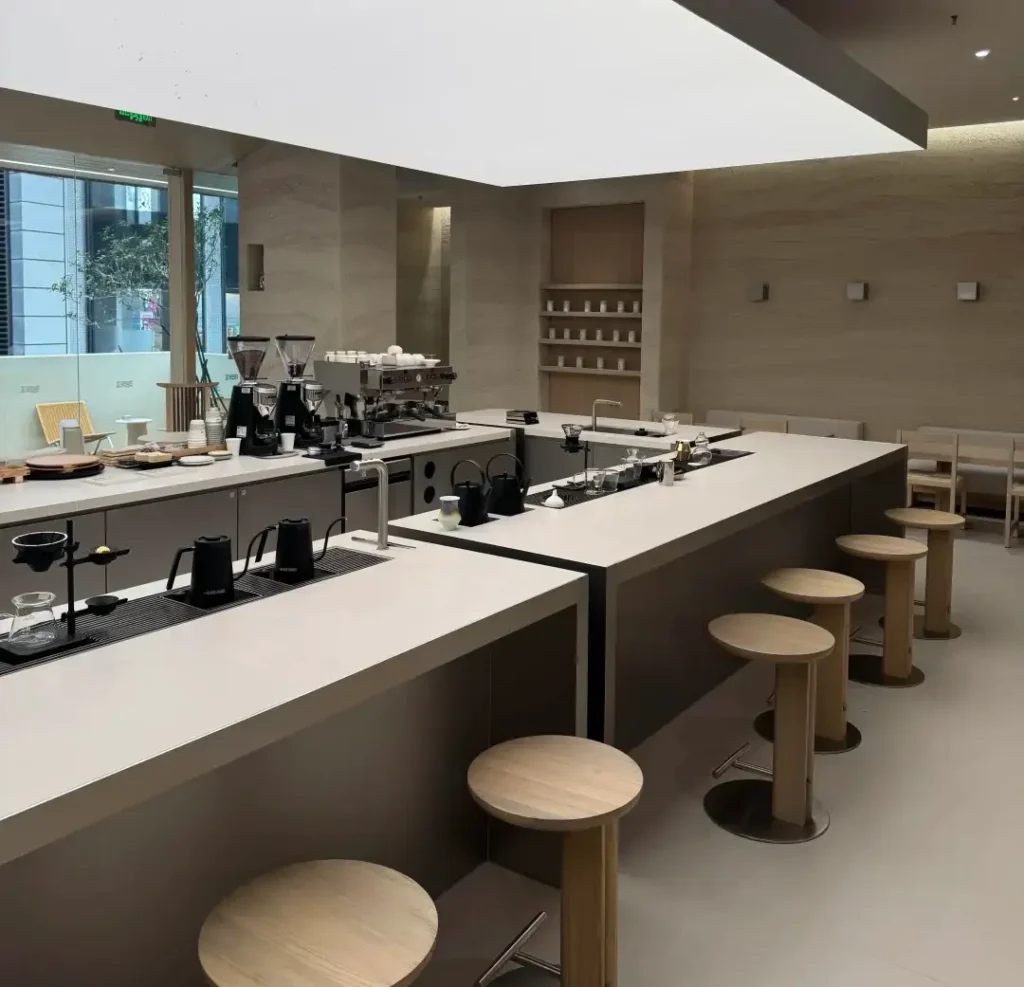
What Does a Complete Coffee Shop Equipment Solution Include?
A complete solution covers every stage from receiving ingredients to serving the finished order and cleaning the equipment. We organize the project by working zone, then confirm how each machine connects with the next task. This prevents a common problem: buying individually suitable products that do not work efficiently together after installation.
| Project zone | Typical equipment | Main purpose |
| Coffee production | Espresso machine and grinders where included in scope, batch brewer, hot-water system, stainless counter | Fast, consistent hot-drink production with correct power, water and counter support |
| Point-of-use refrigeration | Undercounter milk refrigerator, drawer refrigerator or back-bar cooler | Keeps milk, plant-based alternatives, syrups and garnishes within the barista’s reach |
| Reserve cold storage | Reach-in refrigerator, freezer or cold room where required | Stores delivery stock and replenishes the coffee bar without overcrowding the work line |
| Ice and cold drinks | Ice maker, storage bin, blender station, cold-brew or beverage dispenser | Supports iced coffee, tea, smoothies and seasonal cold-drink demand |
| Display and takeaway | Refrigerated pastry display, dry display or grab-and-go merchandiser | Protects product quality while improving visibility and impulse sales |
| Washing and sanitation | Hand sink, dump sink, pitcher rinser, compartment sink or dishwasher | Separates handwashing, waste liquid and warewashing from clean beverage production |
| Preparation and storage | Stainless worktables, refrigerated prep counters, shelving and mobile storage | Provides organized space for food, packaging, ingredients and daily replenishment |
We do not recommend equipment from floor area alone. We first confirm the menu, daily volume, busiest service period, cold-drink share, food offer, delivery frequency, destination market and available utilities. Final models are selected only after these inputs are clear.
How Does Select Equipment for the Actual Menu?
The menu determines the equipment package. A coffee bar focused on espresso and takeaway needs a different refrigeration and ice strategy from a cafe selling smoothies, cold brew, cakes, sandwiches and bottled drinks. We convert each menu item into an equipment requirement: espresso shots, milk volume, ice weight, blender time, chilled ingredients, display temperature and washing load.
How Is Peak Drink Output Calculated?
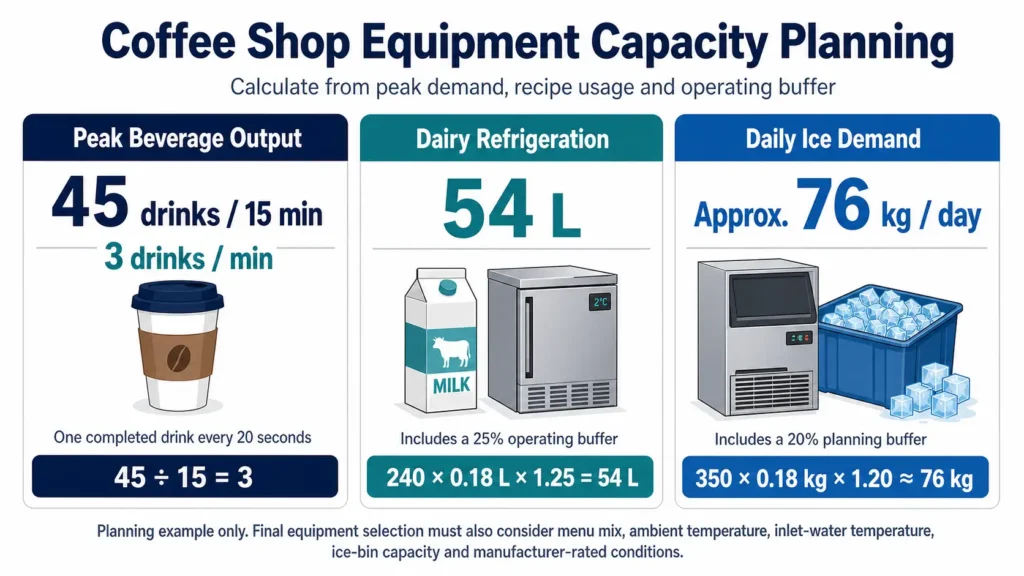
We size the line around the busiest 15-minute period, not only the daily average. If a shop expects 45 drinks in 15 minutes, the team must complete 3 drinks per minute, equal to one finished drink every 20 seconds across the whole bar. This output is shared by grinding, extraction, milk steaming, ice dispensing, blending, finishing and handoff.
The calculation helps us identify the real bottleneck. In one project it may be espresso capacity; in another it may be a single milk-fridge door, a slow blender station, insufficient landing space or a pickup area blocked by waiting customers. Correcting that bottleneck is usually more useful than simply choosing the largest machine.
How Is Milk Refrigeration Capacity Calculated?
Start with recipe volume and replenishment frequency. For example, 240 milk-based drinks using an average of 0.18 L require 43.2 L of milk and milk alternatives. Adding a 25% operating allowance gives 54 L of product. The selected cabinet must be larger than 54 L because bottles, cartons, open containers, shelf spacing and airflow reduce usable storage.
We normally separate cold storage into two levels: an undercounter refrigerator for the active service period and a reach-in refrigerator or cold room for reserve stock. This keeps the bar fast without forcing all daily inventory into the most expensive working area.
How Is Ice Production Capacity Calculated?
Use the actual ice weight in each recipe. If 350 cold drinks require an average of 0.18 kg of ice, base demand is 63 kg per day. A 20% planning allowance increases this to approximately 76 kg per day. The final selection must also consider ambient temperature, incoming-water temperature, peak bin draw, storage capacity and the manufacturer’s rated test conditions.
Production rate and storage-bin size are separate decisions. The ice maker must recover enough ice during the day, while the bin must hold enough for the busiest service period. For hot climates or strongly seasonal menus, we also recommend a practical backup plan instead of relying on the nominal 24-hour rating alone.
Which Refrigeration Equipment Does a Coffee Shop Need?
Why Should Milk Refrigeration Be Placed Under the Coffee Bar?
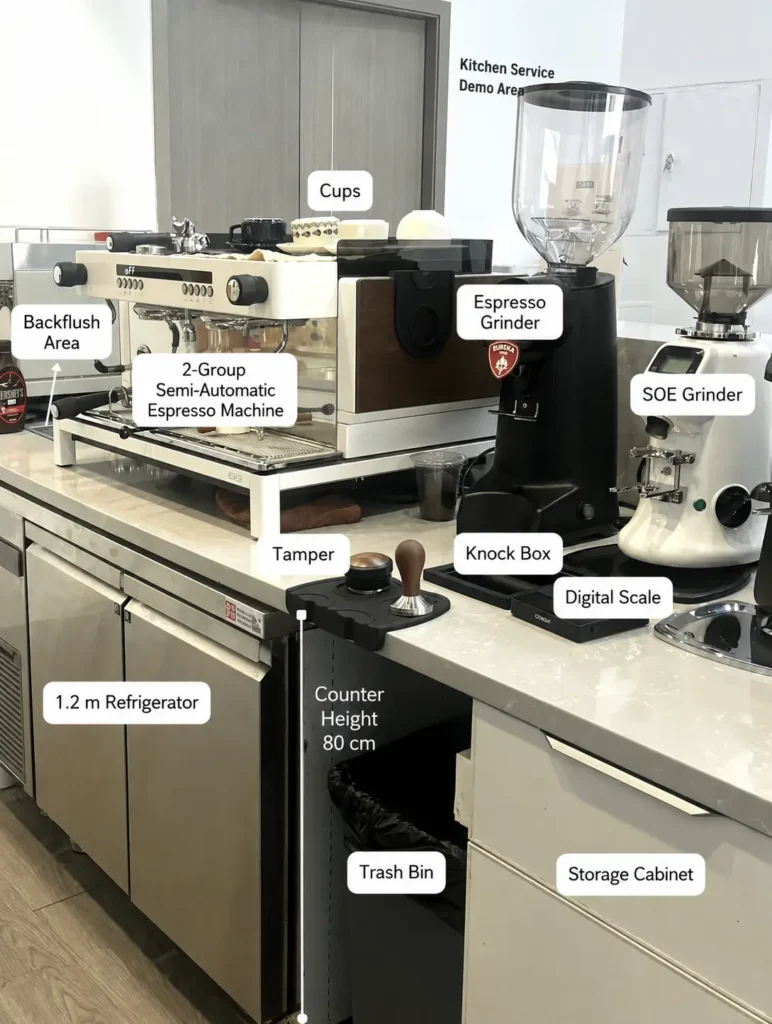
Point-of-use refrigeration reduces unnecessary movement. Milk, cream, plant-based alternatives and cold garnishes should be accessible from the espresso or cold-drink station without crossing another employee’s path. Door or drawer direction matters: an open refrigerator must not block the second barista, the aisle or the pickup route.
For enclosed counters, we check ventilation and service access as carefully as storage volume. A refrigerator that fits the opening but cannot reject heat, clean its condenser or slide out for service is not a suitable project selection.
When Is a Reach-In Refrigerator Required?
A reach-in refrigerator is usually required when the shop receives milk and food in bulk, has a food menu, operates long hours or cannot replenish the bar frequently. It should hold reserve stock without mixing ready-to-serve products, raw food, cleaning materials or overcrowded cartons that restrict airflow.
Which Display Case Fits the Menu?
Use a refrigerated display for cream cakes, dairy desserts, sandwiches and other chilled products; use a dry display only for products that do not require cold holding. The choice should be based on product temperature, shelf dimensions, daily SKU count, loading method, glass visibility and cleaning access, not appearance alone.
Under the FDA Food Code model, time/temperature control for safety food held cold is maintained at 5 C (41 F) or below. The FDA Food Code is a model used by jurisdictions; the adopted local food code and the authority having jurisdiction always take precedence.
Food-safety source: FDA Food Code 2022.
How Should the Coffee Bar Be Laid Out?
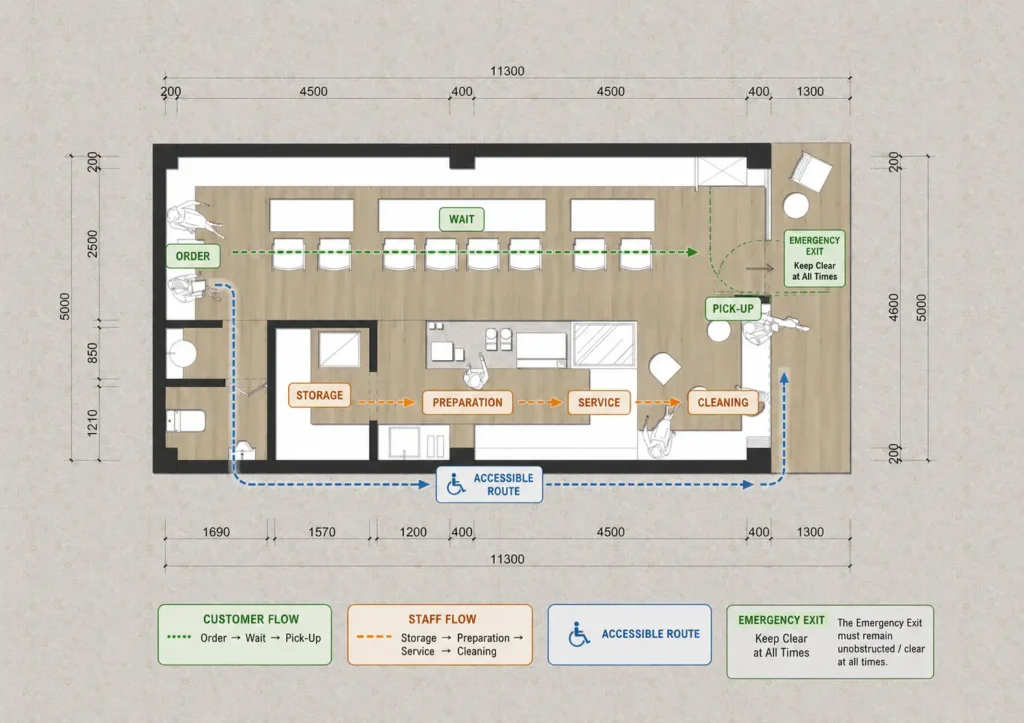
A good layout creates one clear customer route and one efficient staff route. Customers should move from menu and ordering to waiting, pickup, seating or exit without crossing the production line. Staff should move from receiving and storage to preparation, service, return and washing with the fewest possible backtracks.
What Service Sequence Works Best?
- Place the menu and ordering point before the waiting area so the queue remains easy to understand.
- Keep espresso, milk, cups, tools and the knock box inside one compact production cell.
- Create a separate but adjacent ice and blended-drink cell when cold drinks form a significant share of sales.
- Position the display where customers can see it before payment, while staff can replenish it without entering the queue.
- Place pickup after the final drink check and provide enough landing space for takeaway and delivery orders.
- Route waste liquid, used ware and cleaning activity away from clean cups, ice and finished drinks.
Which Space and Accessibility Requirements Should Be Checked?
Toast recommends 18-20 sq ft per guest as a general cafe planning benchmark, but this is not a universal code requirement. For U.S. projects, the 2010 ADA Standards generally require an accessible route at least 36 in (915 mm) wide, at least 5% of dining seating and standing spaces to comply with accessible dining-surface requirements, and an accessible service-counter portion no higher than 36 in (915 mm), subject to the detailed approach rules in Section 904.4.
Layout sources: Toast: How to Design a Cafe Floor Plan and 2010 ADA Standards for Accessible Design. Local building, fire and accessibility codes control the final plan.
Which Utilities Must Be Confirmed Before Ordering?
Before we finalize any model, we confirm the equipment schedule against the site. A correct product with the wrong voltage, insufficient water pressure, no drain, blocked ventilation or inadequate service clearance becomes an installation problem. The project schedule should record the following data for every item.
| Confirmation item | Required project information |
| Dimensions and access | W x D x H, door/drawer swing, packed size, weight, delivery route and final service position |
| Electrical | Voltage, frequency, phase, current or connected load, plug/hardwire method and dedicated circuit |
| Water | Inlet size, pressure, incoming temperature, water analysis, treatment system and shutoff |
| Drainage | Drain size, gravity or pumped connection, air gap, floor drain and condensate route |
| Ventilation and heat | Heat rejection, condenser airflow, installation clearance, exhaust requirement and room ventilation |
| Operating environment | Maximum/minimum ambient temperature, humidity, dust/grease exposure and installation altitude where relevant |
| Maintenance access | Filter, condenser, control panel, fan, compressor and removable-panel access |
| Approval documents | Model-specific electrical, sanitation, energy, refrigerant and market-conformity evidence |
We also check the complete delivery path from the unloading point to the final counter. Doorways, lifts, corners, finished floors and millwork openings must be compared with packed dimensions, not only the operating dimensions shown on a sales page.
How Do We Protect Food Safety and Beverage Quality?
How Should Ice Be Handled?
Ice used in drinks is food. The ice maker, bin, scoop, drain and surrounding work area must be designed for hygienic cleaning and protected from waste liquid, broken glass and hand contact. NSF/ANSI 12 covers automatic equipment used to make, store and dispense ice intended for human consumption.
Ice-equipment standard: NSF/ANSI 12-2023: Automatic Ice Making Equipment.
How Should Water Quality Be Controlled?
Water affects coffee flavour, scale formation, corrosion, filter life and ice output. Before selecting filtration, test TDS, hardness, alkalinity, chlorine or chloramine, pH and incoming-water temperature. SCA training-venue material has referenced 75-250 ppm TDS for cupping water, but the approved coffee-machine and ice-maker water specifications must control the final system.
Coffee-water references: Specialty Coffee Association: Coffee Standards and SCA Premier Training Campus requirements (water quality reference).
Which Certification Documents Should Be Requested?
Certification requirements depend on the destination country and the exact model. For U.S. food-equipment projects, NSF explains that NSF/ANSI 7 covers commercial refrigerators and freezers, including reach-ins, undercounter units, refrigerated preparation equipment and display refrigerators. Electrical listing, energy compliance, refrigerant rules and other conformity documents must be confirmed separately for the destination market.
Refrigeration sanitation standard: NSF Food Equipment Standards.
How Do We Control Energy, Maintenance and Lifetime Cost?
Purchase price is only one part of equipment cost. We also evaluate electricity, water, filters, cleaning chemicals, preventive maintenance, spare parts, technician access and the commercial impact of downtime. The most economical model is the one that meets capacity and compliance requirements with a practical lifetime cost, not automatically the lowest initial price.
ENERGY STAR states that certified commercial refrigerators and freezers are on average 20% more energy efficient than standard models. It also reports that certified batch-type ice makers are about 10% more energy efficient and 20% more water efficient, while certified continuous-type ice makers are about 16% more energy efficient. These benchmarks are useful where eligible products and local programs apply.
Efficiency sources: ENERGY STAR: Commercial Refrigerators & Freezers and ENERGY STAR: Commercial Ice Makers.
For project selection, we compare daily energy and water data at stated test conditions, condenser access, door-gasket replacement, filter cost, cleaning access and local spare-parts support. We also identify high-consequence equipment that may need a backup plan, such as the main grinder, blender, ice supply or point-of-use milk refrigeration.
How Much Should You Budget for Coffee Shop Equipment?
There is no universal equipment price. Bellwether Coffee’s 2026 U.S. guide publishes approximately $20,000-$35,000 for a starter package, $35,000-$55,000 for a standard cafe and $55,000-$80,000+ for a premium or food-service package. Toast separately estimates $25,000-$80,000 to add specialty coffee service. These figures are market benchmarks, not PURUI quotations.
Budget references: Bellwether Coffee: Coffee Shop Equipment List & Costs (2026) and Toast: Essential Cafe Equipment List.
quotation is prepared only after the model, quantity, finish, electrical configuration, certification, accessories, packaging, shipping basis and service scope are confirmed. Freight, import duty, local installation, taxes and site construction should be shown separately so the buyer can compare offers on the same basis.
What Information Does Need to Prepare Your Solution?
Send us the following project information. If an item is not yet available, we will mark it for confirmation instead of inserting an assumed technical value.
- Destination country, city, importer requirements and required certifications.
- Coffee shop concept, complete menu, cup sizes and food offer.
- Expected transactions per day, drinks per day and busiest 15-minute demand.
- Share of espresso, milk-based, iced, blended, cold-brew and takeaway orders.
- Dimensioned floor plan, counter elevations, ceiling height and site photos.
- Voltage, frequency, phase and available electrical circuits.
- Water analysis, water pressure, incoming-water temperature and drainage points.
- Maximum ambient temperature, humidity and ventilation conditions.
- Delivery route, door and lift dimensions, floor level and installation responsibility.
- OEM/ODM requirements for size, finish, branding, accessories, packaging and documentation.

Why Work With for Coffee Shop Projects?
PURUI is focused on overseas B2B equipment supply, OEM, ODM and project matching. Our coffee shop solution brings commercial refrigeration, beverage-bar equipment, refrigerated display, stainless-steel furniture, washing equipment and related kitchen categories into one coordinated discussion. This gives distributors and project contractors one technical brief instead of disconnected product conversations.
- Project-based selection rather than a generic product list.
- Coordination of dimensions, utilities, workflow and service access before order.
- OEM/ODM discussion based on the buyer’s market, quantity and technical requirements.
- Model-specific confirmation of voltage, refrigerant, certification and documentation.
- Clear separation between confirmed data, missing information and items requiring approval.
- Commercial terms, lead time, warranty and pricing confirmed in the written quotation.
How Can You Start Your Coffee Shop Equipment Project?
Send PURUI your menu, expected volume, floor plan, destination country and available utilities. We will use this information to prepare a zone-based equipment recommendation, identify the dimensions and connections that require confirmation, and organize the next technical and commercial discussion around your actual project.
Important: Product model, size, temperature range, power, voltage, refrigerant, certification, MOQ, price, payment terms, lead time and warranty are not final until confirmed in the current PURUI datasheet and written quotation.
What Are the Most Frequently Asked Questions?
What equipment does a coffee shop need?
The final list depends on the menu and service model. Most projects require coffee-brewing equipment, grinders, point-of-use milk refrigeration, reserve cold storage, an ice system for cold drinks, display refrigeration where needed, stainless work surfaces, handwashing and warewashing, water treatment, storage and cleaning equipment.
How do I choose the right undercounter refrigerator?
Choose it by peak milk and ingredient use, package dimensions, door or drawer access, ventilation, ambient temperature and service clearance. The refrigerator should support the rush without blocking another barista or forcing frequent trips to back storage. Final temperature range, capacity, refrigerant, voltage and certification must be confirmed by model.
How large should a coffee shop ice machine be?
Calculate actual ice weight per drink multiplied by daily iced-drink volume, then validate an allowance for the hottest season, incoming-water temperature, ambient temperature, bin capacity and backup supply. Production rate and storage-bin size should be checked separately against the manufacturer’s rated conditions.
How much does a complete coffee shop equipment package cost?
There is no universal price. Equipment mix, quantity, certification, electrical configuration, finish, freight, duty, installation and service scope all change the total. PURUI prepares a written quotation only after the technical brief is confirmed; published third-party budget ranges should be treated as planning references, not offers.
Can provide OEM or ODM coffee shop equipment?
PURUI supports OEM, ODM and project matching within its commercial refrigeration, beverage-bar and related kitchen-equipment scope. Custom dimensions, finish, branding, accessories, documentation, packaging, MOQ, price, lead time and warranty depend on the approved technical brief and must be confirmed before order.
What should I send PURUI before requesting a quotation?
Send the destination market, menu, daily and peak demand, floor plan, utility supply, water information, ambient conditions, required certifications, delivery access and customization requirements. Clear inputs allow us to recommend a more accurate equipment package and identify missing items before commercial confirmation.
Which Sources Support These Planning Figures?
The following sources were accessed on August 16, 2026. Local codes, current standards, manufacturer data and the exact approved model always control the final project.
WebstaurantStore: Coffee Shop Equipment List
WebstaurantStore: How to Start a Coffee Shop
Toast: Essential Cafe Equipment List
Toast: How to Design a Cafe Floor Plan
CKitchen: Essential Coffee Shop Equipment – A Complete Guide
Bellwether Coffee: Coffee Shop Equipment List & Costs (2026)
ENERGY STAR: Commercial Refrigerators & Freezers
ENERGY STAR: Commercial Ice Makers
NSF/ANSI 12-2023: Automatic Ice Making Equipment
2010 ADA Standards for Accessible Design
Specialty Coffee Association: Coffee Standards
SCA Premier Training Campus requirements (water quality reference)
Contact PURUI Today
Looking for reliable commercial refrigeration equipment or customized solutions?
Whether you need standard products or small-scale OEM projects, PURUI can help you build the right refrigeration solution for your business
Products
Choose PURUI Commercial Display Refrigerators to Support Your Business Growth
Projects
Explore PURUI Completed Projects and equipment solutions
Contact Us
Contact PURUI for Project Consultation