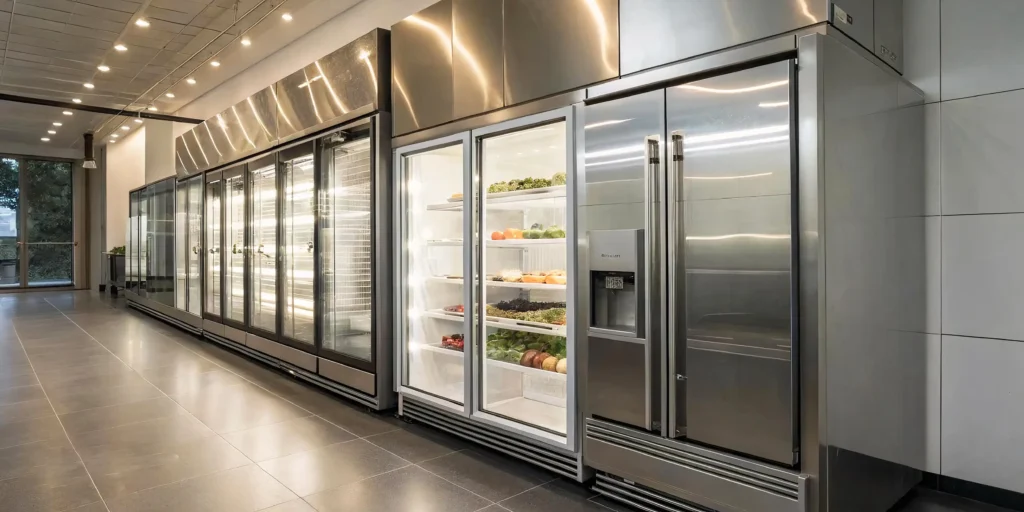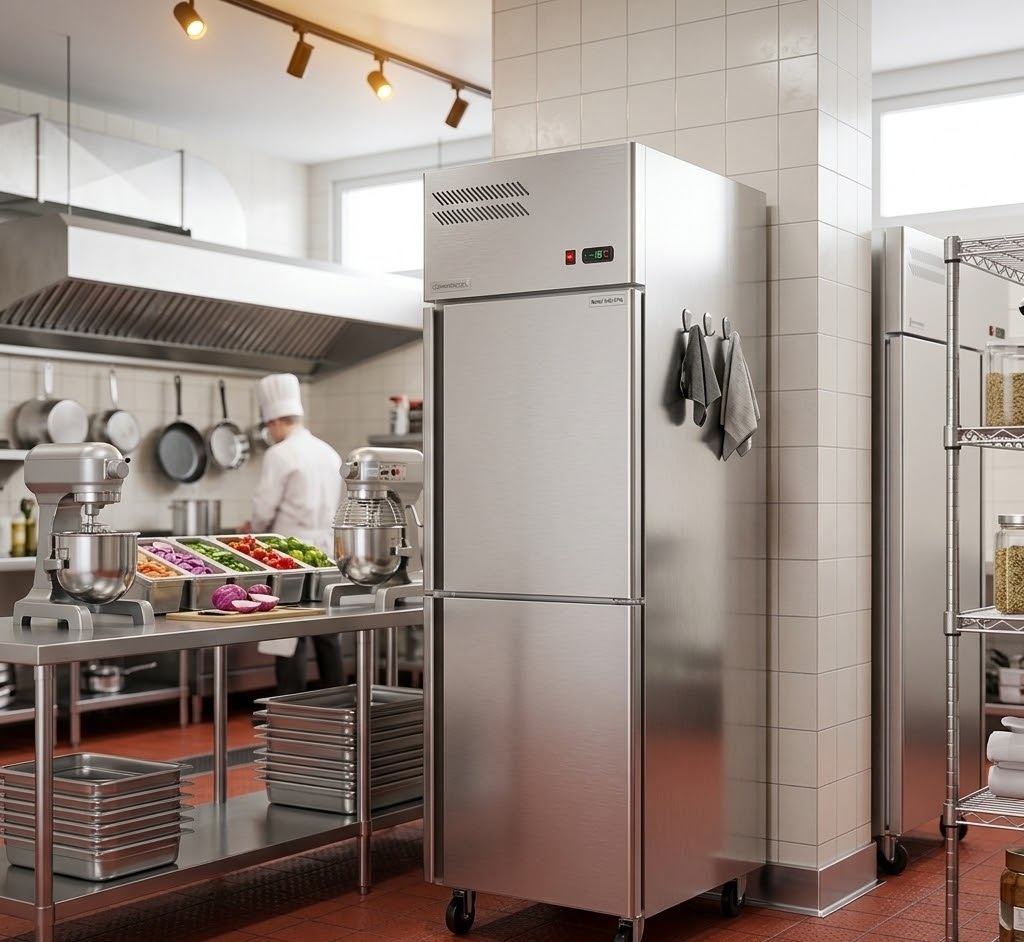
Choose a glass door display chiller by defining the stored product and required holding temperature first. Then match usable capacity, cabinet dimensions, doors, cooling type, compressor position, glass and condensation control to the site. Importers should also verify voltage, refrigerant, ambient rating, energy test data, compliance documents, packaging, service parts and final commercial terms.
The risk is that two cabinets can look almost identical while using different airflow, insulation, glass, defrost and compressor arrangements. A cabinet selected by door count or advertised litres alone may fit the catalogue but fail the actual product, climate, access route or service plan.
This guide gives distributors, refrigeration dealers, kitchen-equipment suppliers, chain buyers and project contractors a quote-ready decision process. It also separates verified PURUI sourcing data from missing or conflicting information, so technical claims do not become accidental commercial promises.
What Is a Glass Door Display Chiller – and What Is It Not?
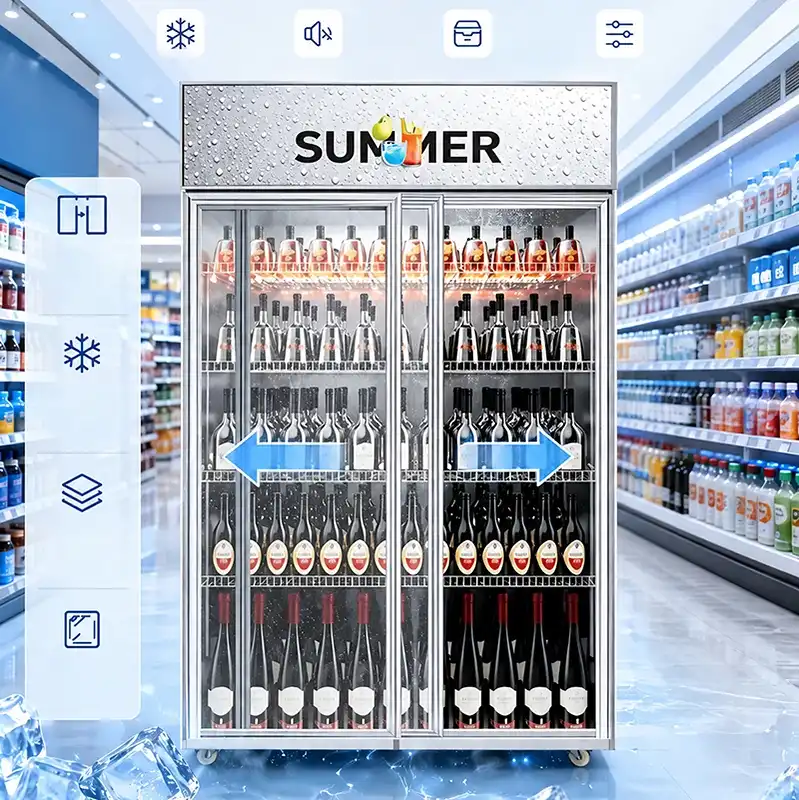
A glass door display chiller is a commercial refrigerated cabinet that keeps chilled products visible while limiting heat and moisture entry with hinged or sliding transparent doors. It is primarily a holding and merchandising appliance. It is not automatically a freezer, a rapid pull-down cabinet or a substitute for a food-safety process that the selected model has not been designed to perform.
That distinction changes the purchase specification. A beverage merchandiser can prioritize visibility, shelf pitch, lighting and customer access. A kitchen reach-in with glass doors may prioritize pan or tray compatibility, cleanability and staff use. A glass door freezer needs a lower-temperature refrigeration system, different insulation and stronger condensation-control strategy than a positive-temperature chiller.
The word capacity also needs discipline. Gross internal volume does not equal saleable display capacity. Evaporator covers, fan ducts, shelf frames, bottle height, required airflow gaps and safe stacking reduce usable space. Buyers should compare shelf dimensions and planograms, not only litre figures.
| Equipment type | Intended use | Buyer implication |
| Glass door display chiller | Chilled beverages, packaged foods or ingredients within the model’s declared range | Visibility plus temperature holding |
| Glass door reach-in refrigerator | Staff-access kitchen storage where visibility assists stock control | Foodservice storage and workflow |
| Glass door display freezer | Frozen products within the model’s declared low-temperature range | Frozen merchandising; not interchangeable with a chiller |
| Open multideck merchandiser | High-access retail display without doors | Faster customer access but a different airflow and energy profile |
What Temperature Range Should the Chiller Maintain?
The correct temperature range is the range required by the product under the applicable local rules and the real operating environment, not the widest range printed in a brochure. Confirm whether the quoted figure describes thermostat settings, cabinet air, average package temperature or a tested product-temperature class. Those measurements are related but not interchangeable.
Air temperature changes quickly when a door opens; product temperature changes more slowly. A display may return its air sensor to setpoint while recently loaded drinks or food remain warmer. X causes Y here: frequent door openings and warm loading increase heat and moisture entering the cabinet, which increases recovery time and can raise product temperature if the refrigeration system, loading pattern or airflow is unsuitable.
The buyer should also separate holding from pull-down. A holding cabinet is expected to maintain products that enter at the correct temperature. If the project expects warm products to be chilled rapidly, request a declared pull-down performance and test method. Do not assume a display chiller can safely cool dense batches of prepared food merely because its thermostat reaches a low setpoint.
| Stored product | Temperature basis | What to verify |
| Bottled or canned beverages | Confirm the brand’s serving requirement and whether food regulation applies | Product presentation, recovery after restocking and shelf airflow |
| Packaged dairy or ready-to-eat food | Confirm the local cold-holding limit and the product manufacturer’s instruction | Measure representative product temperature, not only display air |
| Fresh ingredients for staff use | Confirm food-safety plan, loading method and door-opening frequency | Separate raw and ready-to-eat items where required |
| Frozen merchandise | Use a model explicitly rated as a freezer | A positive-temperature chiller should be avoided |
Food-safety context: the FDA Food Code 2022 is a model used by U.S. jurisdictions and uses 5 C (41 F) or below for cold holding of time/temperature control for safety food. It is not a universal global law; the destination market’s adopted rules control.
How Should Capacity, Dimensions and Door Count Be Chosen?
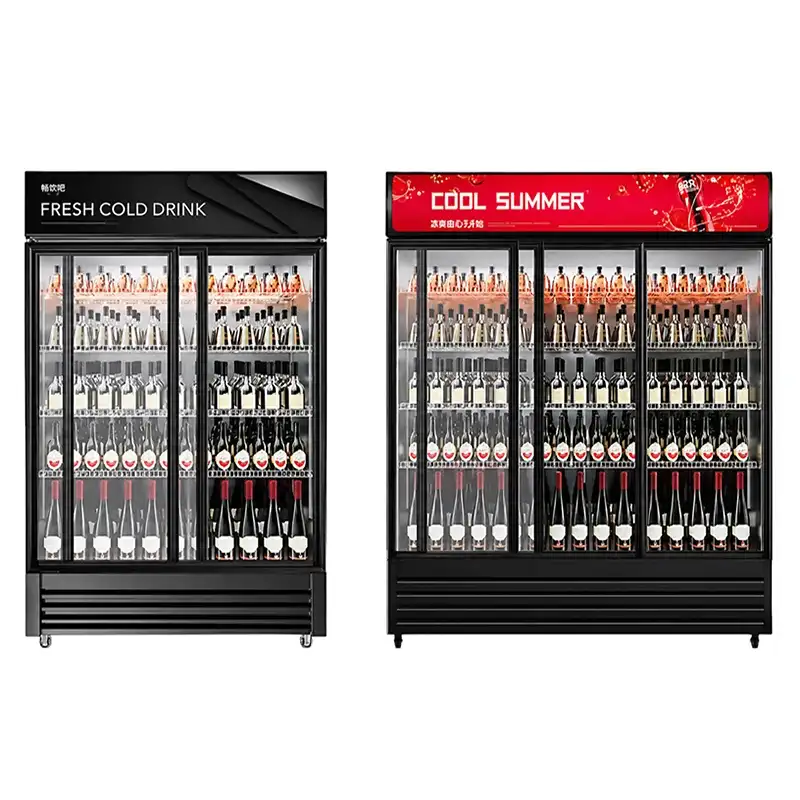
Select capacity from the actual SKU plan, replenishment cycle and shelf layout, then verify that the external cabinet, door movement and delivery route fit the site. More doors create more display width and access points, but they can also increase opening events, gasket length, cleaning work and the number of components that need future replacement.
Start with the planogram. Record bottle or pack width, depth and height; the number of facings; stock behind each facing; shelf count; and the minimum airflow gap required by the manufacturer. Convert that layout into usable shelf area. A high gross litre figure is not useful when tall bottles force shelf removal or evaporator ducts reduce the usable rear depth.
Next, measure the complete physical path: container unloading, warehouse door, elevator, corridor, turning radius, shop entrance and final position. Include casters, light box, handle projection, power lead, drainage where applicable, door swing and service-removal space. X should be avoided when Z: an oversized cabinet should be avoided when it cannot be safely delivered, ventilated or serviced, even if its price per litre looks lower.
| Format | Best fit | Purchase check |
| Single door | Narrow retail zones, focused beverage ranges, small cafes | Check shelf width, restocking frequency and whether one open door exposes most stock |
| Two doors | Medium-volume retail or foodservice display | Balance product segmentation with aisle and door clearance |
| Three or more doors | Broad assortment and high-volume merchandising | Confirm electrical load, floor loading, access route, service plan and packing dimensions |
| Countertop or undercounter | Point-of-sale or limited-height applications | Confirm ventilation path, usable height and heat rejection around the counter |
Expert insight: Compare saleable facings and usable shelf millimetres per unit of floor width. This is more decision-useful than comparing gross litres alone.
Which Cooling Type Is Better: Direct Cooling or Air Cooling?
Air cooling is generally better when the cabinet needs faster temperature recovery and more even air distribution across multiple shelves, especially with frequent door openings. Direct cooling can be suitable for lower-traffic, cost-sensitive applications with simpler construction. Neither method is automatically superior; the stored product, humidity, defrost, ambient conditions and load pattern determine the better choice.
In an air-cooled cabinet, fans move chilled air through defined supply and return paths. Blocking those paths causes warmer zones because air cannot complete the designed circuit. Fan cooling may also increase surface drying for uncovered products, so packaging and product type matter. Ask how the cabinet manages defrost water and whether the fan stops or changes operation when doors open.
Direct-cooled cabinets rely more on cooled surfaces and natural convection. They can have fewer airflow components, but temperature gradients and frost behaviour may be more sensitive to loading position and door use. A lower fan count does not prove lower total energy consumption; energy depends on the whole cabinet, including insulation, glass, gaskets, compressor control, anti-condensation systems and ambient duty.
| Factor | Air cooling | Direct cooling |
| Temperature distribution | Usually stronger shelf-to-shelf circulation when airflow is unobstructed | Can show more location-dependent gradients |
| Recovery after openings | Often better suited to frequent access when correctly sized | Better for less demanding access patterns when confirmed by testing |
| Product exposure | Moving air can dry uncovered products | Lower forced airflow may suit some covered or packaged products |
| Maintenance | Fans, ducts and drains add cleaning and service points | Frost pattern and evaporator cleaning still require attention |
| Decision rule | Choose for high-traffic display and multi-shelf uniformity when verified | Choose for simpler, lower-traffic applications when performance evidence fits |
Which should you choose? Choose air cooling when rapid recovery, high access frequency and broad shelf distribution are central. Choose direct cooling when the access pattern is lighter and the confirmed model meets product-temperature needs at a lower justified system cost. The decision changes if local humidity, uncovered food, defrost requirements or noise limits are critical.
Should Buyers Choose Hinged or Sliding Glass Doors?
Hinged doors usually provide full-width access and can use self-closing hardware, but they need clear swing space. Sliding doors preserve aisle space and can suit narrow customer-facing locations, but tracks, overlaps, rollers and cleaning access must be evaluated. Door choice should follow traffic flow, restocking method, seal design and maintenance capability – not appearance alone.
For hinged doors, check opening angle, handle projection, hinge loading, self-closing behaviour and whether an open door blocks customers or staff. For sliding doors, inspect the removable track, drainage of spills, roller replacement and the central overlap where visibility and sealing can differ from a single pane. Ask for gasket or seal part numbers and replacement instructions for both formats.
Glass specification affects condensation, heat gain, safety and replacement cost. Request the number of panes, safety-glass description, frame construction and the exact anti-condensation method. Heated glass or frame heaters can improve visibility in difficult humidity conditions but add electrical load and components. Low-emissivity coatings or additional panes may reduce heat transfer, but the supplier should document the quoted construction rather than rely on generic phrases such as ‘energy-saving glass.’
| Door type | Strength | Trade-off | Best when |
| Hinged | Full access, simpler visual opening, self-closing options | Requires swing clearance; hinges and closers carry repeated loads | Wide aisles, staff access or restocking priorities |
| Sliding | Preserves aisle space and limits door projection | Tracks and overlaps need cleaning, alignment and seal checks | Narrow retail aisles and customer-facing display |

Why Does Compressor Location Matter?
Compressor location changes cabinet geometry, heat rejection, dust exposure, service access and the space available for products. Bottom, top and rear-mounted arrangements can all work when engineered correctly. The better choice is the one that receives clean ventilation, can be serviced safely and does not conflict with the site’s ceiling, wall, floor or merchandising constraints.
A bottom system is accessible without working at height and can simplify replacement in some shops. It is also closer to floor dust and debris, so condenser cleaning and front or rear access must be practical. The machinery compartment can raise the lowest shelf or reduce lower storage geometry. Do not place stock, cartons or decorative panels where they block the designed intake or discharge.
A top system can keep machinery away from floor contamination and preserve a different lower-cabinet layout. It requires ceiling clearance, safe service access and confirmation that rejected heat will not recirculate into the condenser. A rear system uses cabinet depth and demands a verified wall gap; it should be avoided when the project expects the cabinet to sit flush against a wall without an engineered ventilation path.
| Location | Potential advantage | Main risk | RFQ check |
| Bottom | Ground-level service access; common self-contained layout | Floor dust, blocked kick plates, loss of lower display geometry | Condenser-cleaning route and front/rear ventilation |
| Top | Machinery separated from floor debris; different shelf geometry | Service height, ceiling clearance and warm-air recirculation | Safe access and discharge-air path |
| Rear | Can support specific cabinet and visual designs | Consumes depth and needs rear ventilation/service clearance | Wall gap, pull-out route and condenser access |
Buyer decision: Do not select compressor location as a style feature. Send the supplier a site drawing with ceiling height, wall clearance, adjacent heat sources and the intended service side.

How Do Ambient Conditions and Daily Use Change Real Performance?
Real performance depends on ambient temperature and humidity, airflow around the condenser, door-opening frequency, product entry temperature, loading density and maintenance. A catalogue setpoint does not prove that a cabinet will hold the required product temperature in a hot, humid store with repeated customer access. Buyers should request the declared operating ambient and the test conditions behind performance claims.
High ambient temperature raises the condensing load. High humidity increases moisture entering when doors open and can worsen glass condensation or frost. Frequent openings replace cold cabinet air with warm moist room air. These loads are cumulative: a cabinet near cooking equipment, in direct sun, with blocked condenser airflow and heavy customer traffic faces a different duty from the same cabinet in an air-conditioned showroom.
Loading practice is equally important. Warm cases of drinks should not be placed directly against air returns, evaporator covers or sensors. Overfilled shelves can create short-circuit airflow, where cold air returns without reaching the product zone. Request a loading-line diagram and keep the manufacturer’s required gaps. If rapid restocking is unavoidable, specify the warm-load quantity and recovery target in the RFQ.
What Evidence Should Be Requested for Hot or Humid Markets?
- Declared ambient temperature and relative-humidity conditions for the quoted model, with the applicable climate class or test method where available.
- Temperature-distribution or pull-down evidence that identifies sensor positions, test load, door-opening protocol and pass/fail criterion.
- Glass and frame condensation-control construction, including whether any heater is fitted and its electrical demand.
- Condenser ventilation clearances, filter or coil-cleaning method, drainage and defrost-water route.
- A written statement of any derating, installation limitation or configuration change required for the destination climate.
Red flag: A supplier states only ‘suitable for tropical climate’ but cannot provide a rated ambient condition, construction change or test basis for the exact model.
Which Electrical, Refrigerant and Compliance Details Must Importers Confirm?
Importers must confirm voltage, frequency, phase, plug or connection method, rated power and current, refrigerant type and charge, flammability controls, destination-market standards and the exact model covered by each certificate or report. A compatible voltage label alone is not enough; frequency, starting characteristics, earthing, wiring protection and local conformity requirements can change the installation decision.
Refrigerant should be evaluated as a system and market decision. R290 can support lower global-warming impact than many legacy refrigerants, but it is flammable and subject to equipment-design, charge, marking, servicing and local acceptance conditions. R134a, R600a and other refrigerants may also face market-specific rules or availability constraints. The buyer should not infer global approval from use in one supplier document.
Request the refrigerant charge, circuit count and safety marking for the exact model. Confirm that trained service support and replacement components exist in the destination market. X is better than Y when Z: a lower-impact refrigerant is better when the equipment is compliant, correctly designed, serviceable and accepted locally; it is not a benefit when the buyer cannot legally import or safely maintain the system.
| Evidence level | Meaning | Buyer action |
| Required | Rules adopted by the destination jurisdiction, including electrical safety, energy, refrigerant, food-contact or import requirements | Buyer or local compliance adviser confirms applicability before order |
| Recommended | Official guidance, procurement requirements or customer standards that reduce risk | Record in the RFQ and approval checklist |
| Typical | Common industry configuration or supplier range | Do not present as law or a guaranteed PURUI specification |
| Manufacturer-specific | Exact model construction, ratings, test data and options | Approve a controlled specification sheet and drawing |
| Project-dependent | Ambient duty, plug, colour, stickers, shelving, casters, packing and service parts | Confirm for the destination and order quantity |
Relevant official references include IEC 60335-2-89 for safety of commercial refrigerating appliances; AHRI 1200/1201 for performance rating of commercial refrigerated display merchandisers and storage cabinets; and NSF/ANSI 7 for food-protection and sanitation requirements in its scope. Applicability and certification remain market- and model-specific.
For the United States, review the DOE commercial refrigeration equipment rules and test procedures, the ENERGY STAR commercial refrigerator criteria where certification is claimed, and EPA SNAP listings for stand-alone equipment for refrigerant end-use conditions. These U.S. sources should not be described as universal import rules.
How Should Buyers Compare Total Cost Instead of Only EXW Price?
Compare total cost over the expected operating period: purchase price plus export packing, inland transport, ocean freight, duty, installation, energy, cleaning, planned maintenance, spare parts, repair labour and downtime. A lower EXW price can cost more because weak packaging, poor energy evidence, hard-to-source components or repeated service visits shift cost to the importer after shipment.
Rated input power is not the same as daily energy consumption. Compressor cycling, fans, lights, anti-condensation heaters, defrost and controls determine actual energy use. Ask for measured daily energy consumption, the test standard, rating temperature, ambient conditions and cabinet class. If no comparable test exists, treat an efficiency claim as unverified rather than converting watts into a misleading annual cost.
Freight efficiency also needs controlled data. A 40HQ quantity depends on packed dimensions, orientation, stacking rules, pallet use, accessories, container limits and damage-prevention clearances. A naked-cabinet calculation is not a loading plan. Require a packing drawing and model mix before using loading quantity in a quotation or landed-cost model.
| Cost layer | What it includes | Evidence to request |
| Acquisition | Unit price, option cost, tooling or artwork, samples | Controlled quotation tied to model version and quantity |
| Logistics | Packing, inland freight, container utilization, duty and destination handling | Packed dimensions, gross weight and loading plan |
| Operation | Daily energy, cleaning labour, product loss and restocking efficiency | Comparable test data and operating assumptions |
| Service | Spare parts, diagnostic access, warranty process, technician time and downtime | Parts list, service manual, warranty scope and response route |
| Risk | Damage, compliance failure, incorrect voltage, temperature loss or delayed replacement | Pre-shipment inspection and written acceptance criteria |
Commercial boundary: PURUI can provide quotation suggestions from confirmed configurations. Final price, payment terms, delivery time, discount, warranty and Incoterms require manual approval and written confirmation.
What Should a Professional RFQ and Supplier Audit Include?
A professional RFQ should make every performance, interface and commercial assumption visible. The buyer should send product type, target temperature, ambient conditions, dimensions, access constraints and destination requirements, then require the supplier to return a controlled model sheet. Supplier evaluation should verify evidence, not reward the longest feature list or the lowest unsupported price.
What Information Should the Buyer Send?
- Stored products and whether the cabinet is for packaged beverages, dairy, ready-to-eat food, ingredients or frozen merchandise.
- Required product-temperature range and applicable local cold-holding rule or brand standard.
- Expected ambient temperature and humidity, door-opening frequency, warm-load quantity and daily restocking pattern.
- Maximum external dimensions, delivery-route limits, door swing or sliding preference and installation clearances.
- Shelf plan: product dimensions, facings, shelf count, load per shelf and lighting or label-strip needs.
- Voltage, frequency, phase, plug or connection, destination country and required compliance documents.
- Required colour, material, light box, stickers, cabinet graphics, casters, built-in light colour and other OEM or ODM items.
- Order quantity, target shipment window, preferred Incoterm and whether mixed-model container loading is required.
What Must the Supplier Return Before Approval?
- Exact model and revision, dimensioned drawing, net and gross capacity definition, shelf arrangement and door construction.
- Temperature range with test conditions, cooling type, defrost, controller, compressor location, refrigerant type and charge.
- Rated voltage, frequency, power, current, wiring or plug details and electrical diagram where required.
- Declared ambient duty, ventilation clearances, drainage, cleaning and service-access instructions.
- Applicable certificate and test-report numbers, issuing body, validity, model coverage and any country-specific limitations.
- Packed dimensions, gross weight, packing construction, pallet or stacking method and confirmed loading quantity for the ordered mix.
- Spare-parts list, recommended start-up spares, service manual, warranty scope and claim procedure.
- Final quotation and pro forma invoice tied to the approved specification. Commercial terms remain subject to manual confirmation.
Which Supplier Red Flags Matter Most?
- One model name is reused for different capacities, dimensions or compressor positions without a revision code.
- Temperature is promised without an ambient condition, test load, sensor location or door-opening protocol.
- A certification logo is shown, but the supplier cannot prove that the exact quoted model is within scope.
- The quote lists R290 or another refrigerant but omits charge, circuit count, safety markings or market conditions.
- 40HQ quantity is calculated from cabinet dimensions rather than final packed dimensions and an actual loading plan.
- Warranty wording is vague, spare-parts references are missing or the service route depends on returning a complete cabinet internationally.
Which Glass Door Display Chiller Configuration Should You Choose?
Choose the smallest configuration that holds the required assortment and temperature under the real ambient and access pattern, while preserving delivery, ventilation and service access. Upgrade cooling, glass or condensation control only when the site duty justifies it. The final choice should be a controlled specification, not a catalogue photo with optional features left undefined.
| Application | Configuration direction | Condition that can change the choice |
| Small cafe or narrow retail zone | Single door or compact format; hinged or sliding according to aisle | Usable shelf plan, ventilation and restocking frequency |
| Convenience store beverage display | Two- or three-door, strong visibility, adjustable shelves, verified recovery | Door traffic, warm-load recovery, lighting and daily energy data |
| Hot and humid market | Documented ambient duty and condensation-control package | Glass construction, heaters, seals, drainage and condenser airflow |
| High-traffic packaged food | Air-cooled configuration when test evidence supports uniformity and recovery | Product-temperature evidence and local food rules |
| Narrow customer aisle | Sliding doors when track maintenance and sealing are acceptable | Track cleaning, overlap, roller and seal replacement |
| Project with limited rear clearance | Top or bottom machinery arrangement engineered for the site | Discharge path, ceiling/floor conditions and service access |
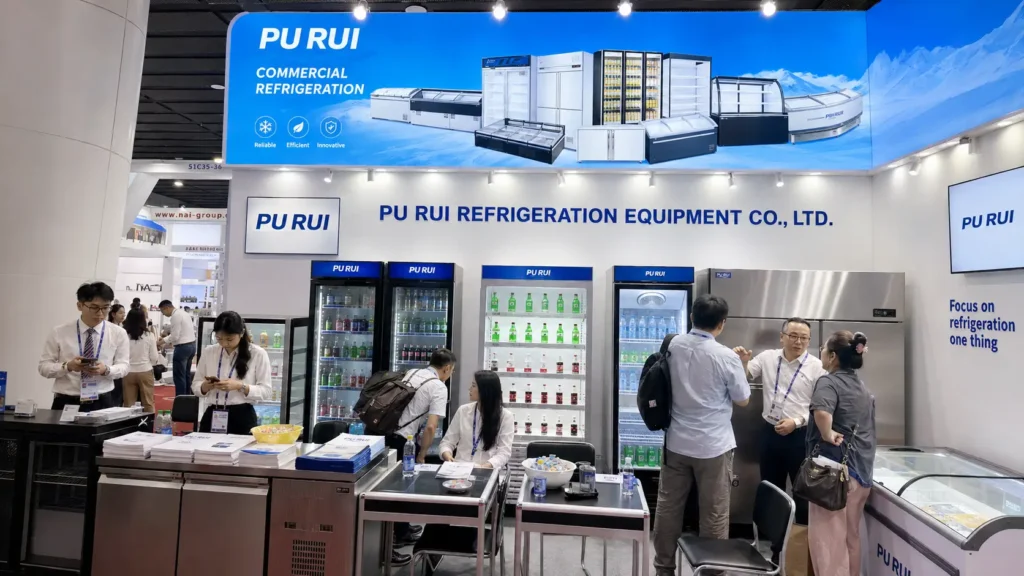
A basic cabinet is sufficient when product is packaged, access is moderate, ambient conditions are controlled and verified temperature performance meets the requirement. A higher-cost glass, airflow or control package is justified when humidity, opening frequency, brand presentation, energy testing or food-safety risk creates a measurable need. An upgrade is not worthwhile when the supplier cannot define the construction or provide evidence for the claimed benefit.
What Are the Most Frequently Asked Questions?
Can PURUI customize a glass door display chiller?
PURUI source files list potential customization for external structure colour, light box, cabinet stickers, refrigeration method, shelf quantity, caster size, built-in light colour and other accessories. The classification files also list hinged or sliding doors and steel or aluminium construction as decision fields. Every option is manufacturer- and model-specific and needs factory confirmation before quotation.
What is the MOQ for a glass door display chiller?
Information missing / needs confirmation. MOQ can depend on the factory, model, colour, artwork, electrical configuration, certification, mixed-container plan and whether customization requires new materials or tooling. Ask for both the standard-model MOQ and the customized-model MOQ, then have the final quantity approved manually.
How can condensation on glass doors be reduced?
First control the cause: room humidity, door openings, damaged seals, blocked airflow and unsuitable installation. Then verify the specified glass, frame, anti-condensation heater or coating, drainage and controller logic. Heated glass can help in difficult conditions but adds energy demand, so it should be selected from documented site requirements rather than applied automatically.
Can a glass door display chiller be used as a freezer?
No, unless the exact model is designed, rated and documented for frozen operation. A chiller setpoint does not create freezer-level insulation, glass, defrost, compressor capacity or condensation control. Select a commercial glass door display freezer for frozen products and verify its low-temperature performance and market compliance.
Which documents should be approved before paying a deposit?
Approve the final specification sheet, model revision, dimensioned drawing, electrical and refrigerant data, option list, artwork, applicable certificates, packing method, spare-parts list, warranty scope, inspection criteria, quotation and pro forma invoice. Final price, payment, delivery and discount terms require manual confirmation.
What Is the Final Purchase Decision?
If the cabinet is for packaged beverages in controlled indoor conditions, prioritize usable display area, door access, shelf plan, verified holding performance and daily energy evidence. If the cabinet will hold temperature-sensitive food, add local food-safety requirements and product-temperature verification. If the site is hot, humid or high-traffic, require a documented ambient and condensation-control solution.
The choice changes when the delivery route, ventilation, voltage, refrigerant acceptance, certification or service network cannot support the preferred configuration. In that case, select a serviceable and compliant alternative rather than forcing the visually attractive model into an unsuitable project.
Send PURUI the stored product, required temperature, ambient conditions, dimensions, door preference, voltage/frequency, destination market, order quantity and customization brief. PURUI can support model selection, OEM or ODM review, project matching and quotation suggestions. Final specifications and commercial terms require manual written confirmation.
Authority Sources
IEC 60335-2-89:2019 – Safety scope for commercial refrigerating appliances and ice-makers; confirm adopted edition and market applicability.
U.S. Department of Energy – Commercial Refrigeration Equipment – U.S. energy conservation standards and test-procedure references; U.S.-specific.
ENERGY STAR Commercial Refrigerators and Freezers Criteria – Eligibility and transparent-door performance criteria where ENERGY STAR certification is relevant.
AHRI 1200/1201 – Performance rating of commercial refrigerated display merchandisers and storage cabinets.
NSF Food Equipment Standards – NSF/ANSI 7 – Food-protection and sanitation requirements within the standard’s scope.
FDA Food Code 2022 – U.S. model food code used here only as clearly labelled cold-holding context.
U.S. EPA SNAP – Stand-alone Equipment – U.S. refrigerant acceptability and use conditions by end use; not a universal global approval.
Contact PURUI Today
Looking for reliable commercial refrigeration equipment or customized solutions?
Whether you need standard products or small-scale OEM projects, PURUI can help you build the right refrigeration solution for your business
Products
Choose PURUI Commercial Display Refrigerators to Support Your Business Growth
Projects
Explore PURUI Completed Projects and equipment solutions
Contact Us
Contact PURUI for Project Consultation