Quick Answer: For 2026 buyers, there is no single best commercial refrigeration manufacturer. Haier/Carrier Commercial Refrigeration and Dover fit large retail systems; Daikin/AHT is strong in plug-in and natural-refrigerant solutions; Arneg suits design-led supermarkets; True fits foodservice; PURUI is a flexible OEM/ODM option for customized display refrigeration.
Last verified: August 13, 2026. This comparison is based on current manufacturer information, regulatory sources and publicly available industry data. It is a buyer-fit shortlist, not a global revenue or market-share ranking.
Why does choosing a commercial refrigeration manufacturer matter more in 2026?
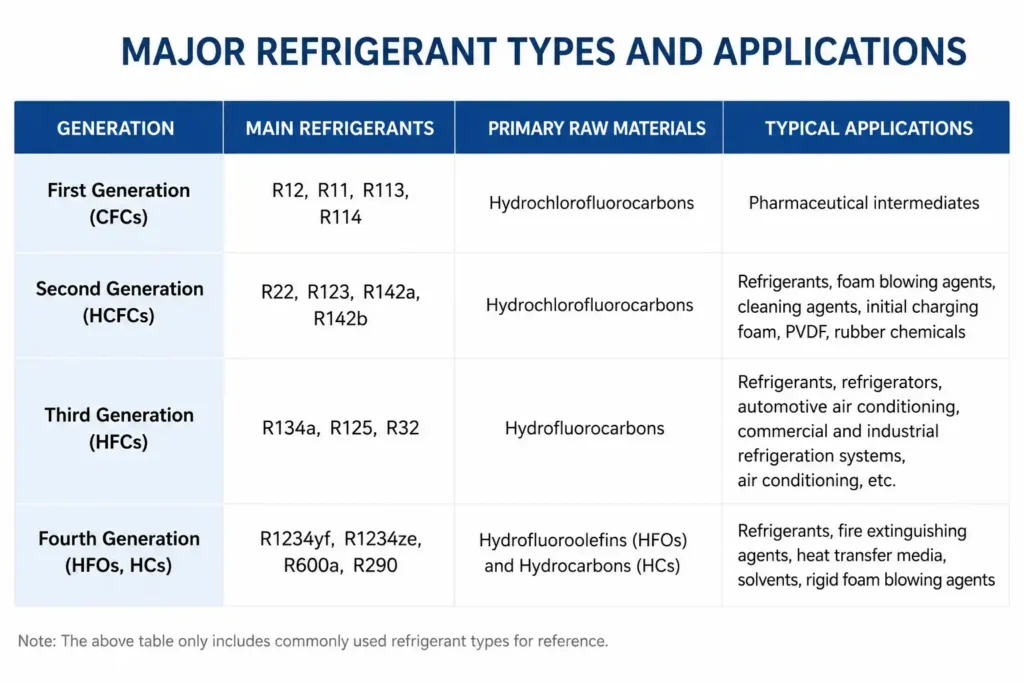
Commercial refrigeration is becoming a larger and more technically demanding procurement category. Fortune Business Insights estimates the global commercial refrigeration equipment market at USD 54.19 billion in 2026, rising from USD 51.66 billion in 2025, with a projected 5.4% CAGR from 2026 to 2034. [1]For buyers, however, market size is less important than lifecycle performance. A refrigeration supplier affects electricity consumption, food safety, merchandising visibility, maintenance requirements, spare-parts availability and the total cost of ownership over many years.The refrigerant transition is another major issue. European regulation is tightening restrictions on fluorinated greenhouse gases, while commercial refrigeration manufacturers increasingly offer natural-refrigerant technologies such as R290 propane and R744 CO2.

How was this 2026 manufacturer shortlist selected?
Instead of ranking companies only by brand recognition, this guide evaluates manufacturers from the perspective of a commercial buyer. Five factors are considered:
- Product Fit: Does the manufacturer serve supermarkets, foodservice, beverage retail or OEM buyers?
- Refrigeration Technology: Does it offer modern energy-efficient and natural-refrigerant solutions?
- Compliance Readiness: Can products be configured for major export markets?
- Service & Lifecycle Support: Are warranty, parts and technical support clearly available?
- Customization: Can the manufacturer adapt dimensions, appearance, refrigeration systems and electrical specifications?
Because manufacturers disclose different financial and production data, assigning an artificial numerical score would create false precision. The table below therefore identifies the best-fit application for each manufacturer instead of claiming an unsupported global ranking.
Which commercial refrigeration manufacturers should buyers compare in 2026?
| Manufacturer | Best Fit in This Guide | Verifiable Strength | Technology Direction | Buyer Consideration |
| Haier / Carrier Commercial Refrigeration | Large supermarkets and integrated retail refrigeration | Haier completed its approximately USD 775 million acquisition of Carrier Commercial Refrigeration in 2024; the acquired business included 4,000+ employees and established European/APAC operations. [2][3] | CO2 refrigeration, integrated food-retail systems and established commercial refrigeration brands | Best suited to buyers needing large-scale infrastructure and established service networks rather than small-volume private-label sourcing. |
| Dover Food Retail | Supermarkets, display systems and large CO2 projects | Dover Food Retail operates brands including Hillphoenix, Anthony, Advansor and The AMS Group. In 2025 Dover announced a USD 20+ million Virginia expansion expected to create more than 300 jobs. [4] | CO2 transcritical systems, refrigerated cases, glass doors and aftermarket support | Strong system engineering capability, but procurement may be more complex than buying standardized plug-in cabinets. |
| Daikin + AHT Cooling Systems | Plug-in supermarket refrigeration and natural-refrigerant projects | Daikin acquired AHT to expand from HVAC into commercial refrigeration and complete its cold-chain portfolio. Its 2026 refrigeration catalogue includes R290 and CO2 solutions. [6][7] | R290 plug-in cabinets, CO2 systems and integrated cold-chain technology | Especially relevant to retailers prioritizing plug-and-play installation and natural refrigerants. |
| Arneg | Design-led supermarkets and complete retail environments | Arneg states that it has more than sixty years of commercial refrigeration experience and operates internationally through multiple retail-equipment brands. [8] | Commercial display cabinets, centralized systems, natural refrigerants and retail-store integration | Strong choice for sophisticated retail design; smaller importers may not require its full system-integration capability. |
| True Manufacturing | Restaurants, hotels, cafes and professional foodservice | True states that its commercial refrigeration warranty covers parts, labor and compressor for up to seven years on applicable products. [9] | Self-contained R290 refrigeration, reach-ins, prep units and merchandisers | Strong foodservice positioning, but less focused on deep OEM/private-label customization than specialist export factories. |
| PURUI | Importers, distributors and chain buyers requiring OEM/ODM customization | Manufacturer-reported capability includes a 20,000+ m2 manufacturing facility, 200+ personnel and customizable commercial refrigeration and beverage-bar equipment. | R290 options, glass-door display refrigeration, commercial freezers, worktables and customized refrigeration equipment | Buyers should verify model-specific certifications, energy data and destination-market requirements before placing orders. |

When is Haier / Carrier Commercial Refrigeration a strong choice?
Haier should now be considered the owner behind the former Carrier Commercial Refrigeration business. Carrier officially completed the sale in October 2024 for an enterprise value of approximately USD 775 million, while Haier confirmed that more than 4,000 employees and brands including Carrier Commercial Refrigeration, Profroid, Celsior and Green & Cool joined its commercial refrigeration platform. [2][3]This makes Haier/CCR particularly relevant for supermarket chains and large food-retail projects that require integrated refrigeration infrastructure, CO2 technology and a mature international service organization.
Best for: large supermarket groups, multi-store rollouts and integrated food-retail projects.
When is Dover Food Retail a strong choice?
Dover Food Retail combines multiple specialized refrigeration businesses instead of relying on one product family. Its portfolio includes Hillphoenix commercial display cases and systems, Anthony glass refrigeration doors, Advansor CO2 technology and The AMS Group aftermarket services. [4]Dover’s continued investment is visible in its 2025 announcement of more than USD 20 million for its Virginia manufacturing campus, with more than 300 new jobs projected. Advansor has also reported more than 16,000 CO2 systems designed and produced since 2006. [4][5]
Best for: supermarket refrigeration systems, CO2 projects and buyers requiring sophisticated system engineering.
When is Daikin with AHT a strong choice?
Daikin acquired AHT to strengthen its ability to provide refrigeration across the complete cold chain. AHT is especially associated with self-contained and plug-in supermarket cabinets, while Daikin’s 2026 refrigeration portfolio covers commercial, industrial and transport refrigeration with both R290 and CO2 technologies. [6][7]AHT had already reported more than 2 million R290 units sold worldwide by 2021, giving buyers a useful indicator of installed experience with propane-based plug-in refrigeration. [13]
Best for: supermarkets looking for plug-in refrigeration, fast installation and natural-refrigerant technology.
When is Arneg a strong choice?
Arneg focuses heavily on the relationship between refrigeration, store layout and retail design. The company describes more than 60 years of experience and continues to present commercial refrigeration innovations at major retail exhibitions such as EuroShop 2026. [8]For premium supermarket projects, this ability to integrate refrigerated cabinets with the wider store environment can matter almost as much as cooling capacity itself.
Best for: supermarkets where merchandising, design and complete-store integration are major priorities.
When is True Manufacturing a strong choice?
True is particularly strong in professional foodservice refrigeration. A representative True T-49-HC reach-in refrigerator is designed to maintain approximately 0.5C to 3.3C and uses R290 refrigerant. [10]Service and warranty are also important differentiators. True states that applicable commercial refrigeration products are supported by a seven-year parts, labor and compressor warranty. [9]
Best for: restaurants, hotels, professional kitchens and foodservice operations that prioritize established service support.
When does PURUI make sense as an OEM/ODM refrigeration partner?
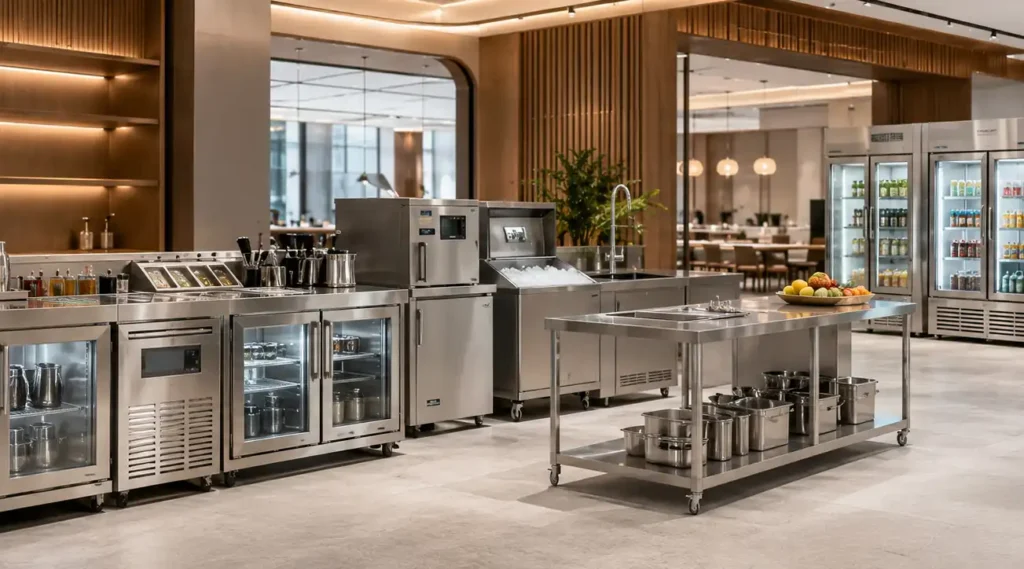
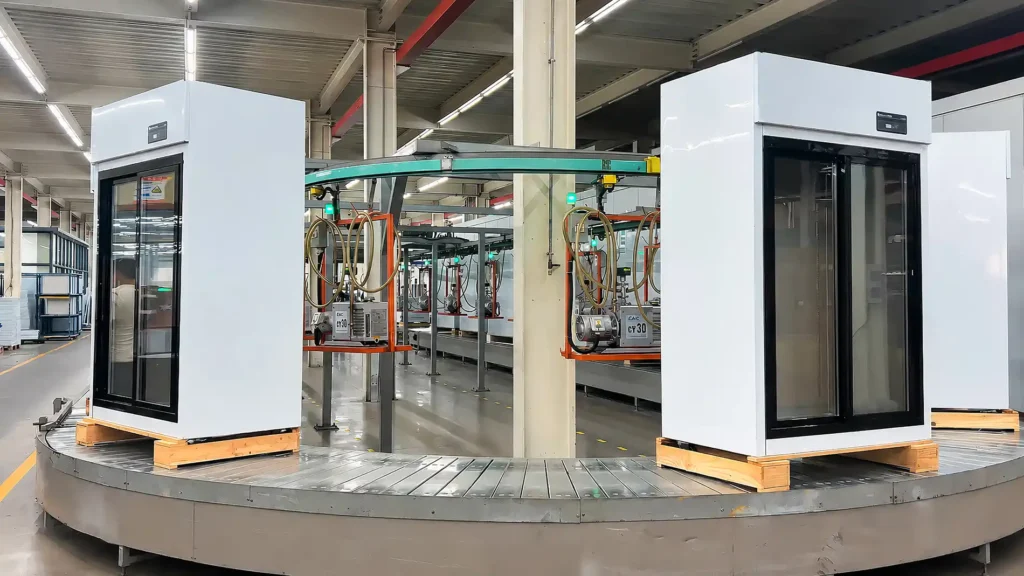
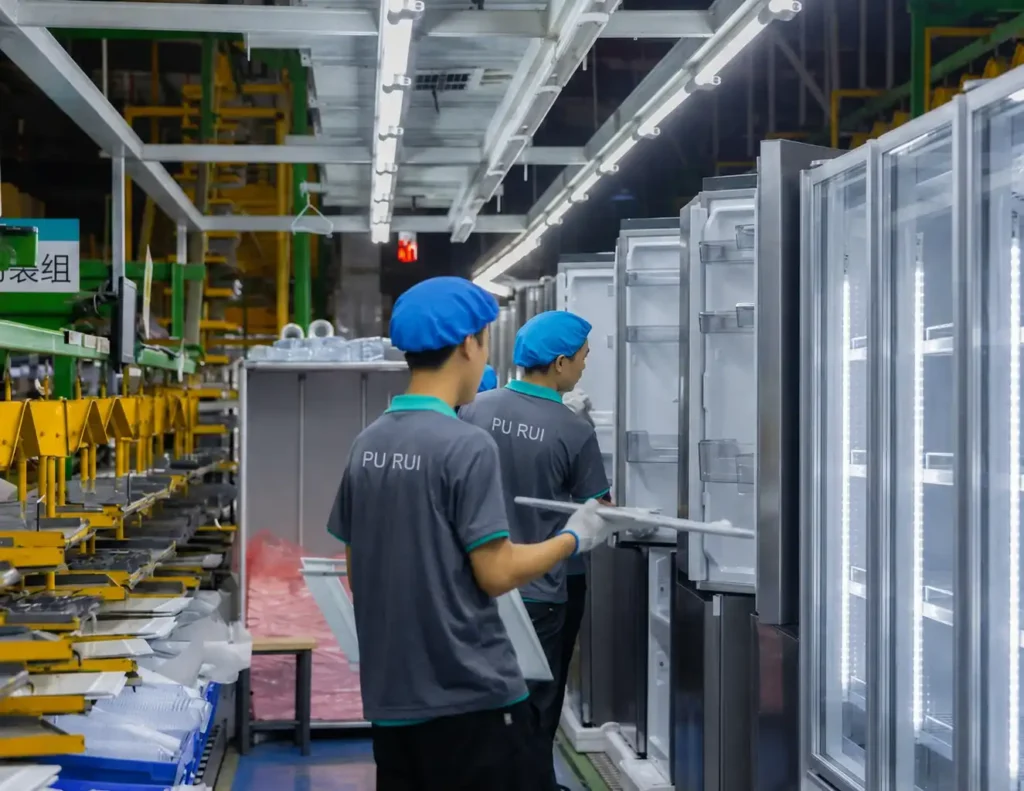
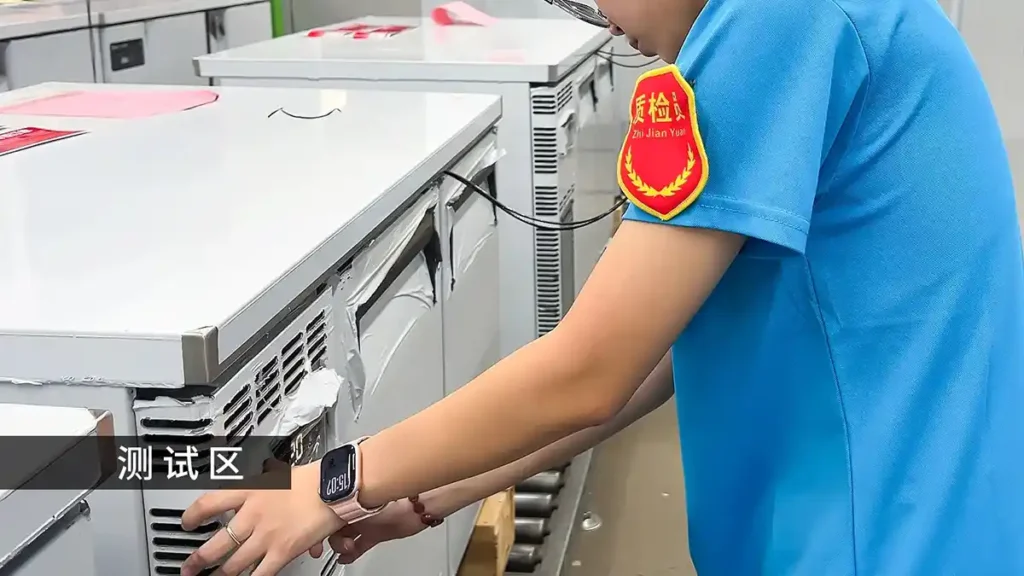
PURUI occupies a different position from large multinational refrigeration groups. Rather than competing primarily through global branch networks, PURUI focuses on factory-direct manufacturing, flexible customization and integrated commercial refrigeration solutions.Manufacturer-reported production capability includes a 20,000+ m2 manufacturing facility and 200+ personnel. Core product areas include glass-door display refrigerators and freezers, supermarket refrigeration, refrigerated worktables, beverage-bar refrigeration and stainless-steel commercial kitchen equipment.For OEM and ODM buyers, customization can include cabinet dimensions, door configuration, temperature range, exterior finish, shelving, branding, voltage/frequency, refrigeration configuration, packaging and other project-specific requirements.Typical manufacturer-reported production lead time is approximately 20-50 days depending on product and customization. PURUI’s current warranty policy is one year for the complete unit and two years for the compressor, subject to the final order agreement.These figures should be verified against the quotation, technical specification and sales contract for each project rather than treated as universal specifications for every model.

Which refrigerant strategy should buyers prioritize in 2026?
There is no universal answer. The correct refrigerant depends on cabinet size, system architecture, installation environment, local regulation, technician availability and service requirements.
When does R290 make sense?
R290 propane is increasingly used in self-contained commercial refrigerators and freezers. Manufacturers such as AHT and True already use it extensively in plug-in equipment. [10][13]For importers buying glass-door merchandisers, upright refrigerators, undercounter equipment or other self-contained cabinets, R290 can therefore be an important option to evaluate.
When does CO2 R744 make sense?
CO2 technology is particularly prominent in larger supermarket and centralized refrigeration projects. Dover Food Retail’s Advansor and Hillphoenix portfolios and the commercial refrigeration business acquired by Haier both demonstrate continued industry investment in CO2 technology. [3][5]Instead of asking a supplier only ‘Which refrigerant do you use?’, buyers should ask for the refrigerant type, refrigerant charge, system architecture, applicable safety requirements and local service capability.

What compliance evidence should buyers request for different markets?
A logo on a brochure is not enough. Buyers should verify whether the specific model being purchased complies with regulations applicable to the destination market.
What should European buyers verify?
European buyers should check applicable Ecodesign and Energy Labelling requirements for commercial refrigerators with a direct sales function as well as current F-gas requirements. [11][12]Ask the supplier to identify the exact regulation and test documentation applicable to the model rather than simply stating ‘CE available.’
What should U.S. buyers verify?
The U.S. Department of Energy regulates covered commercial refrigerators, freezers and refrigerator-freezers. DOE’s latest amended efficiency standards become mandatory for covered equipment manufactured on or after January 22, 2029. [14]Before ordering, U.S. buyers should therefore confirm which DOE requirements, safety certifications and sanitation standards apply to the exact product category and sales channel.
What should Middle East, Southeast Asian and Central Asian buyers verify?
Requirements vary by country, so buyers should request confirmation of voltage, frequency, plug type, ambient operating conditions, refrigerant rules, labeling requirements and any local conformity certification before mass production.For hot-climate markets, do not accept the phrase ‘tropicalized refrigeration’ without supporting data. Ask the manufacturer to state the rated ambient temperature and test condition used to verify cooling performance.

How should buyers compare the real five-year cost of a commercial refrigerator?
Purchase price alone can be misleading. A useful commercial refrigeration comparison should calculate:5-Year TCO = Purchase Price + Freight & Import Cost + Electricity + Maintenance + Replacement Parts + Downtime CostFor example, assume refrigerator A consumes 4 kWh less electricity per day than refrigerator B. At an electricity price of USD 0.15/kWh, the difference over five years is approximately:4 x 365 x 5 x USD 0.15 = USD 1,095That USD 1,095 difference exists before maintenance and downtime are considered. For a chain deploying 100 cabinets, the same illustrative energy difference becomes USD 109,500 over five years.This is why professional buyers should request measured or standardized daily energy consumption, not rely only on compressor power or rated input wattage.
What data should buyers request before comparing quotations?
To compare two refrigeration suppliers fairly, every quotation should use the same technical and commercial assumptions.
| Data to Request | Why It Matters |
| Exact model and dimensions | Prevents comparisons between different cabinet sizes. |
| Net / gross capacity | Shows usable storage rather than exterior size alone. |
| Temperature range | Confirms suitability for beverage, food or frozen products. |
| Rated ambient condition | Critical for hot markets and high-load retail environments. |
| Daily energy consumption | Allows genuine lifecycle-cost comparison. |
| Refrigerant type and charge | Impacts regulation, service and sustainability. |
| Voltage / frequency | Must match the destination country’s electrical system. |
| Certifications and test reports | Shows whether the exact model can be sold in the destination market. |
| Warranty terms and spare parts | Reduces lifecycle risk after installation. |
| MOQ, lead time and packaging | Affects project timing, cash flow and shipping cost. |
| Customization options | Confirms whether branding, dimensions or temperature specifications can be adapted. |
How should buyers choose the right manufacturer?
The right manufacturer depends less on brand size and more on project fit. A supermarket group may need integrated CO2 systems and local service. A restaurant chain may prioritize warranty and standardized foodservice equipment. An importer or distributor may care more about OEM/ODM flexibility, order communication, packaging, replacement parts and documentation for the target market.Buyers should shortlist suppliers by application first, then compare technical data, compliance evidence, warranty, lead time and five-year cost. This approach is more reliable than choosing only by a generic manufacturer ranking.
FAQ
Who is the best commercial refrigeration manufacturer in 2026?
There is no single best manufacturer for every buyer. Haier/Carrier and Dover fit large retail systems, Daikin/AHT is strong in plug-in and natural refrigerants, Arneg suits design-led supermarkets, True fits foodservice, and PURUI is positioned for flexible OEM/ODM display refrigeration.
Is R290 better than CO2 for commercial refrigeration?
R290 is often suitable for self-contained plug-in equipment, while CO2 is common in larger supermarket and centralized systems. The better option depends on equipment type, local regulation, service capability and installation environment.
What should importers verify before ordering commercial refrigerators?
Importers should verify exact model dimensions, temperature range, rated ambient condition, energy consumption, refrigerant type and charge, voltage/frequency, certifications, warranty, spare parts, packaging, MOQ and production lead time.
Why should buyers calculate five-year TCO instead of only purchase price?
Energy consumption, maintenance, replacement parts and downtime can outweigh a small upfront price difference. A cabinet that saves 4 kWh per day can save about USD 1,095 over five years at USD 0.15/kWh.
When is PURUI a suitable refrigeration supplier?
PURUI is suitable for importers, distributors and chain buyers that need factory-direct OEM/ODM customization for display refrigeration, commercial freezers, refrigerated worktables and beverage-bar equipment.
Sources
[1] Fortune Business Insights – Commercial Refrigeration Equipment Market Size, Share & Industry Analysis.
[2] Carrier Global – Carrier completes sale of Commercial Refrigeration business to Haier, October 2024.
[3] Haier Smart Home – Acquisition / commercial refrigeration platform information for Carrier Commercial Refrigeration, Profroid, Celsior and Green & Cool.
[4] Dover Food Retail – Company portfolio and 2025 Virginia manufacturing expansion announcement.
[5] Advansor – CO2 refrigeration systems company information and installed-production experience.
[6] Daikin – Acquisition of AHT Cooling Systems and cold-chain strategy information.
[7] Daikin / AHT – 2026 refrigeration catalogue and natural refrigerant product information.
[8] Arneg – Company profile and commercial refrigeration experience.
[9] True Manufacturing – Commercial refrigeration warranty information.
[10] True Manufacturing – T-49-HC reach-in refrigerator specification / R290 information.
[11] European Commission – Ecodesign and Energy Labelling requirements for refrigerating appliances with a direct sales function.
[12] European Commission – F-gas regulation and fluorinated greenhouse gas restrictions.
[13] AHT Cooling Systems – R290 plug-in refrigeration installed base / product information.
[14] U.S. Department of Energy – Commercial refrigerators, freezers and refrigerator-freezers amended efficiency standards.